
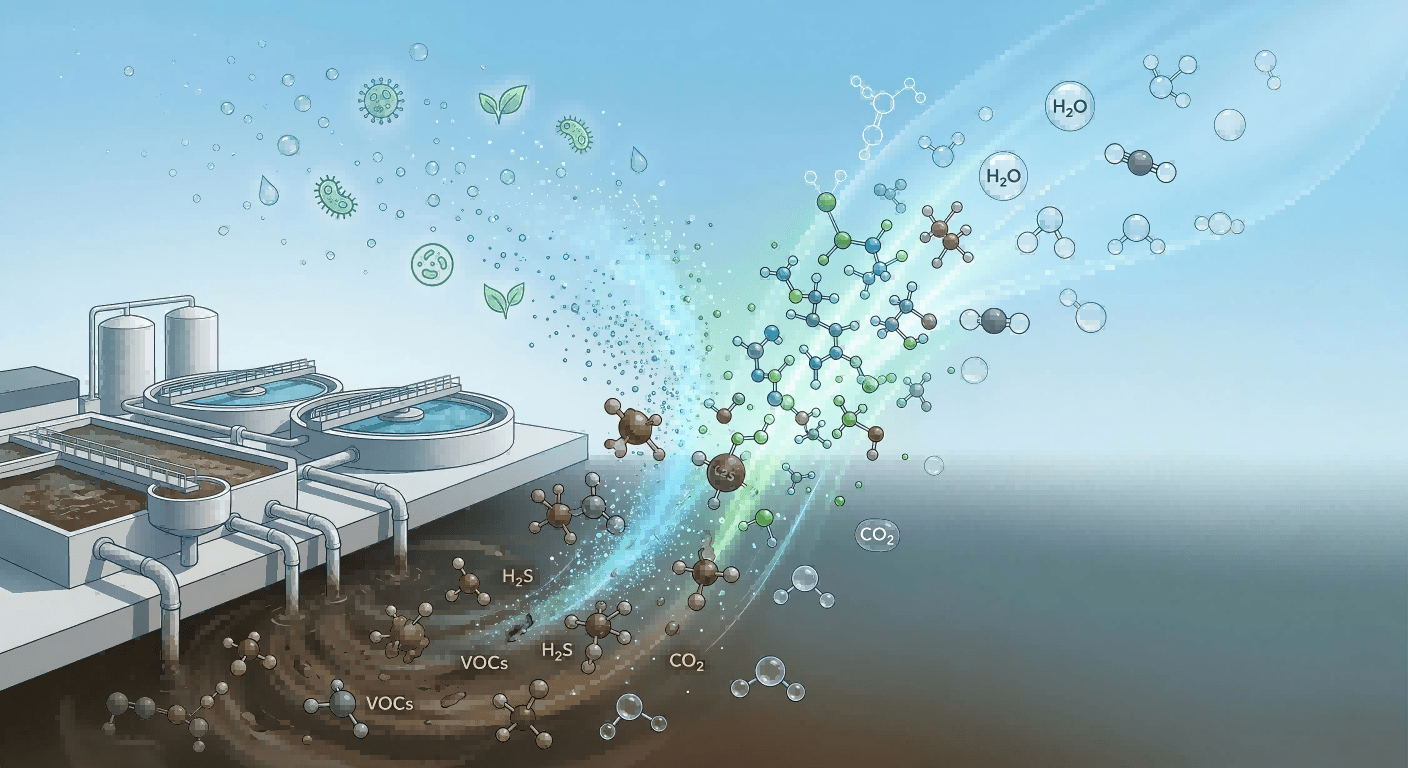
Wastewater smells. That’s unavoidable. But left unmanaged, those smells become far more than a nuisance.
Wastewater odor removal is the process of preventing, neutralizing, and eliminating foul-smelling gases from sewage systems and treatment facilities. It protects worker health. It shields nearby residents from persistent odor complaints. And it keeps facilities compliant with environmental regulations.
This guide covers the root causes of wastewater odor, the most effective treatment technologies, and how to choose the right solution for your site.
Where Do Wastewater Odors Come From?
Understanding the source is always the first step.
The primary culprit is hydrogen sulfide (H₂S) — the infamous “rotten egg” smell. It forms when sulfate-reducing bacteria break down organic waste under low-oxygen, anaerobic conditions. The result is a colorless, toxic gas that spreads quickly and is detectable even at very low concentrations.
But H₂S is not alone. Wastewater environments also release ammonia, mercaptans, volatile organic compounds (VOCs), and indoles. Together, these compounds create a complex odor profile that’s difficult to manage with a single solution.
The highest-risk areas within a treatment facility typically include:
- Headworks and bar screens — where raw sewage first enters
- Wet wells and force mains — where stagnant, oxygen-depleted conditions build up
- Primary clarifiers — where organic solids settle and decompose
- Sludge dewatering areas — where concentrated biosolids release intense odors
- Open aeration basins — large, uncovered areas where gases drift freely
Each zone has different odor intensity and compound types. That’s why a tailored, zone-by-zone approach — like those offered through Airsafer’s industrial odor solutions — delivers far better results than a one-size-fits-all system.
Why Odor Control Cannot Be Ignored
The consequences of poor odor control go well beyond unpleasant smells.
Health and safety. H₂S is acutely toxic. Even brief exposure at moderate concentrations can cause headaches, nausea, and respiratory distress. Prolonged exposure at higher levels is life-threatening. Most occupational health standards cap permissible H₂S exposure at just 10 ppm for workers. Facilities that ignore this face serious liability.
Infrastructure damage. Hydrogen sulfide reacts with moisture to form sulfuric acid. This attacks concrete structures, corrodes metal pipes, and degrades electrical components. Uncontrolled emissions accelerate deterioration — and repair costs — significantly.
Community relations and compliance. Odor complaints from nearby residents are among the most common triggers for regulatory inspections. Failure to act can result in fines, operational restrictions, and lasting reputational damage. Proactive odor control is always cheaper than reactive crisis management.
Key Wastewater Odor Removal Technologies
Modern wastewater odor removal relies on vapor-phase treatment — capturing and neutralizing odorous air before it disperses. Several technologies are widely used, and the best choice depends on the size, layout, and odor intensity of your facility.
Dry Fog Atomization
Dry fog systems disperse ultra-fine mist particles — typically under 10 microns — that remain airborne long enough to contact and neutralize odorous molecules. Because the droplets are so small, they evaporate before landing on surfaces. There is no wetness, no ice formation in winter, and no surface damage.
The Airsafer ASX-06 Dry Fog Deodorization System takes this further with oil-based plant extract concentrates and particles under 1 micron. It covers up to 250m² per unit, clears odors in as little as 5 minutes, and requires minimal maintenance — a single 200ml refill lasts up to 30 days. It’s an excellent fit for pump stations, headworks buildings, and enclosed treatment zones.
For facilities with multiple odor zones, the ASX-09 Centralized Dry Fog System offers a powerful centralized solution. A single host unit drives up to 9 separate atomization boxes simultaneously, with a quiet 150W motor and an ultra-low flow rate of just 2ml/H. One installation can cover an entire treatment building — with a refill cycle of 30 to 90 days.
Two-Fluid Spray Atomization
Two-fluid systems use compressed air and liquid deodorizer together to generate a fine spray mist. The mixing action increases coverage and penetration compared to single-fluid systems.
The AQE Two-Fluid Spray System from Airsafer produces particles in the 2–6 micron range. Each atomizer covers up to 25m², and the system supports 3 to 9 nozzles per unit. It features a fully programmable smart timer and customizable tank sizes. It’s well-suited to wastewater treatment plants, waste transfer stations, and large industrial facilities where scheduled dosing cycles are needed.
High-Pressure Hydraulic Spray
For very large open areas — outdoor basins, landfills, expansive factory floors — high-pressure systems deliver wide-area coverage that smaller units cannot match.
The ALMC High-Pressure Industrial Odor Neutralizing System operates at 7MPa using a premium Italian ceramic plunger pump. It produces 1–25 micron micro-mist particles and scales from 50 to 500 nozzles. That translates to coverage areas from 1,250m² up to 12,500m² in a single installation. An automatic proportional dosing system blends concentrate with water automatically — no manual mixing required. This is the right choice for large wastewater treatment plants with open-air treatment zones or sludge drying fields.
Choosing the Right Technology
There is no universal solution. Selecting the right system requires matching technology to your specific situation.
Odor intensity and compound type matter most. High-concentration H₂S calls for robust misting or high-pressure systems. Lower, more diffuse odors may be managed effectively with centralized dry fog units.
Coverage area is the next factor. Small enclosed rooms suit the ASX-06 or ASX-09. Medium zones work well with the AQE two-fluid system. Massive open areas demand the ALMC high-pressure approach.
Climate conditions also play a role. High-humidity environments can affect some systems. Oil-based dry fog systems like the ASX-06 perform consistently regardless of ambient humidity — an important advantage in tropical or coastal regions.
Maintenance capacity is often overlooked. Facilities with limited maintenance staff benefit from systems with long refill cycles and self-protecting logic, such as auto-shutdown for water shortages or motor overload.
For a detailed comparison of options, visit Airsafer’s industrial odor solutions page.
A Practical Action Plan
Getting started doesn’t have to be complicated. Follow this straightforward process:
- Map odor hotspots. Walk the facility with an H₂S monitor. Identify the worst emission points.
- Characterize your odor. Determine which compounds are present and at what concentrations.
- Match technology to zone. Select the right system for each area based on size, odor intensity, and coverage needs.
- Install and program. Set dosing schedules for peak and off-peak hours. Automate wherever possible.
- Monitor continuously. Use real-time sensors. Act on data — not on neighbor complaints.
- Review seasonally. Odor intensity changes with temperature and operational load. Adjust system settings accordingly.
Final Thoughts
Effective wastewater odor removal is both a technical challenge and a community obligation. The right system — whether dry fog, two-fluid spray, or high-pressure atomization — makes a measurable difference in safety, compliance, and community relations.
Start with the source. Choose the right technology for each zone. And monitor consistently over time.
To explore purpose-built wastewater odor removal systems, visit Airsafer or contact the engineering team for a custom site assessment.
Get a Custom Odor Control Solution Today