
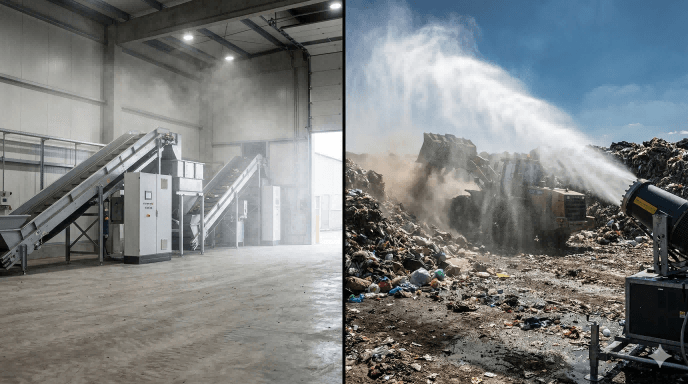
The Real Challenge at Waste Transfer Stations
Walk into a waste transfer station and you understand immediately. The smell hits first. Then the dust. And if the bay doors are open, the wind carries both straight past whatever odor barrier you thought you had.
This isn’t a mild nuisance. Waste transfer stations are one of the harshest environments for odor control equipment. You’re dealing with three overlapping threats at once: fugitive emissions (H₂S, ammonia, and VOCs escaping from open tipping floors), high wind (bay doors and loading docks create constant air movement that disperses treatment), and airborne dust (fine particulate from shredded waste and vehicle traffic).
Any system that can’t handle all three will underperform. That’s why engineers keep landing on two competing technologies: dry fog and high-pressure misting. Both work — but for very different zones within the same facility.
Dry Fog: Built for Enclosed Spaces
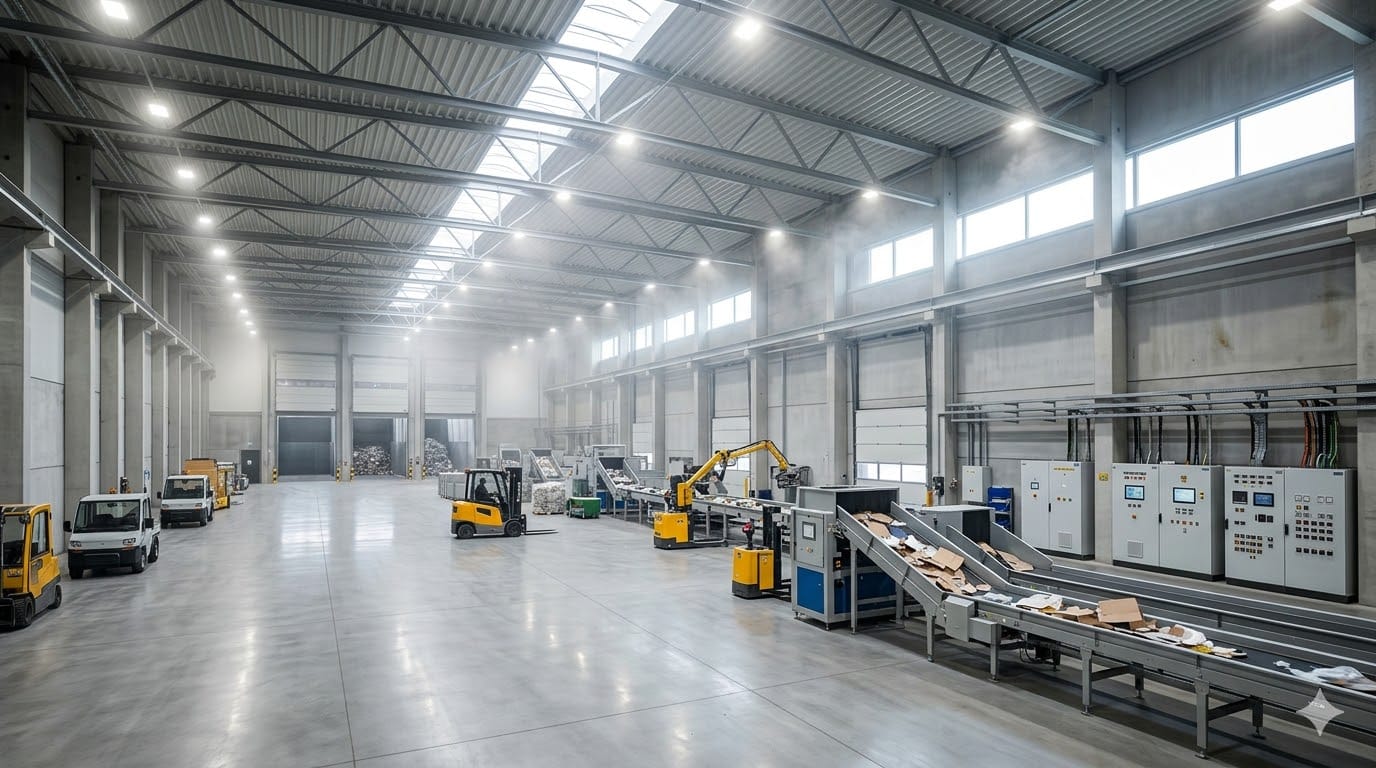
True dry fog produces droplets smaller than 30 microns in diameter. At that scale, droplets stay suspended in the air column instead of falling under gravity. They travel with the airstream. They don’t pool. And critically — they don’t wet surfaces, equipment, or waste loads.
That last point matters a lot indoors. In an enclosed unloading hall, you can’t afford to spray moisture onto electrical panels, conveyor systems, or processing equipment. Wet floors create slip hazards. Excess moisture accelerates corrosion on steel structures.
Dry fog sidesteps all of that. Deodorant molecules are atomized into a cloud that contacts odor molecules directly in the air. Neutralization happens mid-air, not on surfaces — effective odor suppression with no measurable increase in surface moisture.
High-Pressure Misting: Built for Wind and Dust
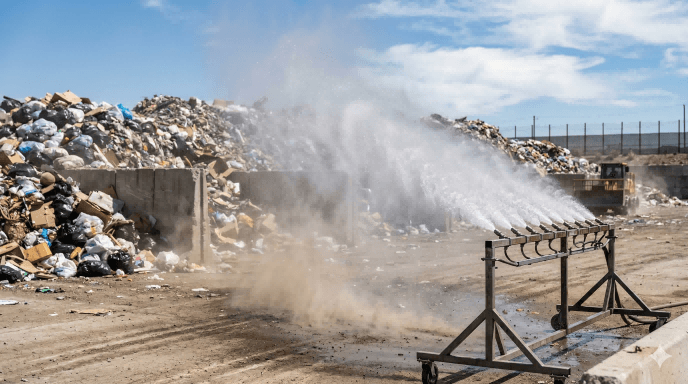
High-pressure misting forces liquid through precision nozzles at 70 to 150 bar. That pressure is the key variable. It mechanically shears the liquid into droplets in the 50–200 µm range — larger and heavier than dry fog particles. They carry real momentum. And that momentum means they can do something dry fog cannot: push through wind.
In outdoor environments, low-pressure fog simply drifts away. Wind above 2–3 m/s disperses it before it can contact odor sources. High-pressure misting solves this because the droplet trajectory is driven by kinetic energy, not air movement. A well-configured nozzle array can project a treatment plume 20–40 meters into a crosswind and still maintain effective coverage at the target zone.
There’s a secondary benefit too: dust suppression. Larger droplets collide with and capture airborne dust particles through inertial impaction — pulling PM10 and above down to the ground. For outdoor waste tipping areas where dust and odor coexist, that dual action matters.
Side-by-Side Comparison
| Parameter | Dry Fog | High-Pressure Misting |
|---|---|---|
| Droplet size | < 30 µm | 50–200 µm |
| Operating pressure | Low (pneumatic) | 70–150 bar (hydraulic) |
| Surface wetting | None | Unsuitable for sensitive indoor equipment |
| Wind resistance | Effective up to ~2 m/s | Effective up to 6–8 m/s |
| Coverage pattern | Diffuse fill of enclosed volume | Directional throw, 10–40 m projection |
| Dust suppression | Negligible | Strong — inertial impaction |
| Best environment | Indoor enclosed spaces | Outdoor open areas with crosswind |
The wind threshold is the deciding factor. Dry fog is exceptional in still or low-movement air — it distributes evenly and neutralizes odors with very low chemical consumption. But above 2 m/s, it loses coherence. High-pressure misting doesn’t have that limitation. Its ballistic droplets can be aimed upwind, creating a chemical curtain that odor-laden air must pass through.
Surface wetting is the indoor constraint. High-pressure misting droplets, while fine, are still large enough to settle on surfaces over time. In a covered hall with electronics and conveyors, that accumulation creates corrosion, tripping hazards, and equipment failures. Dry fog evaporates before reaching any surface — that’s not a feature, it’s physics.
Chemical consumption differs too. Because dry fog droplets are extremely small, they present enormous surface area per unit of liquid. A small volume of deodorant concentrate goes a long way. High-pressure misting uses more liquid overall — partly because the larger droplets carry more mass, and partly because outdoor systems need to compensate for wind dispersion by maintaining higher output rates. Neither is inherently wasteful for its intended zone, but it’s worth factoring into operating cost calculations when comparing systems across applications.
Zone-by-Zone System Selection
Indoor Unloading Halls and Enclosed Tipping Floors
For enclosed spaces, specify a dry fog system. The ASX-06 is designed for large-volume indoor environments — generating a consistent sub-30-micron aerosol that fills the tipping hall without any moisture risk to equipment below. The ASX-09 steps up for higher-throughput facilities where odor flux rates demand broader coverage.
Both systems support automated chemical dosing that integrates with facility ventilation controls — running harder during peak unloading, backing off during idle periods.
Indoor tipping floor? Specify ASX-06 or ASX-09.
Outdoor Open Dumping Areas and Exposed Tipping Pads
For open pads with crosswind and dust, specify a high-pressure system. The ALMC High-Pressure Odor Neutralizing System operates at 70–150 bar and delivers the projection range needed to create effective chemical curtains in real-world wind conditions. Nozzle arrays configured around the perimeter of an open tipping pad — directed inward against prevailing wind — form a continuous neutralizing barrier. The droplet size also knocks down vehicle-generated PM10 dust as a secondary benefit.
Outdoor open area with wind and dust? Specify the ALMC system.
When You Need Both
Many large transfer stations have both an enclosed tipping hall and an outdoor compaction or staging area. In that case, the answer isn’t a choice — it’s deploying both technologies, each in the zone it was designed for.
Zone-matched deployment delivers better suppression at lower chemical consumption. It also reduces maintenance complexity, because each system operates within its design envelope rather than being pushed into conditions it wasn’t built for. Forcing a single technology across both zones almost always means compromising one environment.
Think of it this way: a high-pressure system installed indoors will wet surfaces and raise humidity. A dry fog system deployed outdoors will lose coverage the moment wind picks up above a light breeze. Neither failure mode is acceptable at a facility where odor complaints directly affect operating permits and community relations. Getting the zone match right isn’t over-engineering — it’s just the minimum specification for a system that actually works.
Final Takeaway
Dry fog and high-pressure misting are complementary solutions with clearly defined operating envelopes. The selection isn’t either/or — it’s zone-by-zone.
- Indoor tipping halls → ASX-06 or ASX-09
- Outdoor open areas → ALMC High-Pressure System
For a complete selection methodology — including chemical dosing requirements, nozzle placement density, and system sizing across different waste throughput volumes — visit the AirSafer Industrial Odor Solution Guide.
Get a Custom Odor Control Solution Today