
Why Commercial Locker Rooms Smell (And Why Masking Doesn’t Work)
Walk into most commercial locker rooms — a gym, a factory, or a cleanroom facility — and you catch the same thing: dampness, stale sweat, and that sour undertone of mildew. The typical reflex is to mount a fragrance dispenser on the wall. Something floral. Something fast.
Five minutes later, the floral scent is still there. So is the mildew. You haven’t fixed anything — you’ve just added another layer on top.
The Real Causes of Locker Room Odor
Locker room odor isn’t one problem. It’s several sources feeding into each other.
Uncontrolled humidity. The EPA identifies moisture as the single biggest factor in mold growth. Its mold remediation guide says it directly: mold grows within 24–48 hours when moisture sits on organic surfaces. Locker rooms — shower steam, wet towels, sluggish ventilation — are moisture traps by design. Mildew odor is not mysterious. It is a predictable result of the humidity-mold cycle.
Drain biofilm. Shower drains accumulate a gelatinous mat of bacteria, skin cells, soap residue, and hair — biofilm. This living layer pumps out volatile sulfur compounds (the rotten-egg smell) and amines (the fishy, ammonia-like note). Every time water runs, these gases get pushed into the breathing zone.
Sealed enclosures with negative pressure. Many locker rooms sit deep inside buildings with no windows. HVAC systems pull air out to contain odors — as CDC/NIOSH guidelines recommend — but without enough makeup air, you get stagnant pockets where humidity and odor concentrate. The CDC guidance calls for balanced ventilation: exhaust the odors without trapping them.
Absorbent textiles. Towels, gym clothes, mop heads, carpeted mats. They soak up moisture and odor compounds, then release them slowly over hours. Facility managers constantly underestimate this.
Masking vs. Elimination: The Difference That Matters
Spraying fragrance over locker-room odor is like painting over mold. It buys you a day, maybe less.
Fragrance masking agents overpower your nose with something stronger. They do nothing to lower humidity, break apart odor molecules, or dislodge biofilm in drains.
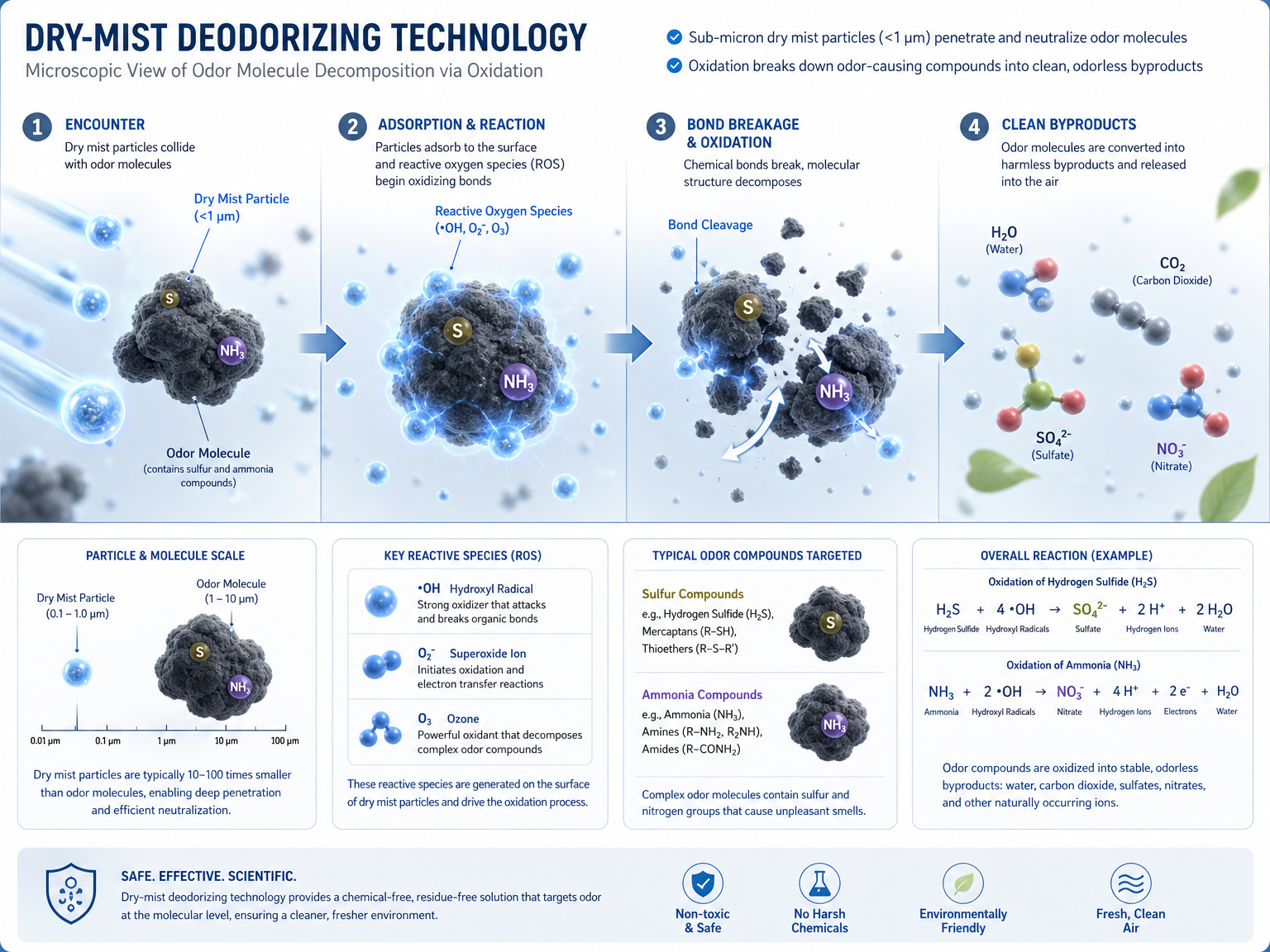
True odor elimination requires active molecular decomposition. Dry-mist deodorizing systems break odor molecules at the chemical level — oxidizing ammonia into nitrogen and water, binding hydrogen sulfide into inert sulfur compounds. You’re not covering the smell; you’re making the molecules that cause it disappear.
Key takeaway: Masking is a sensory trick. Elimination is chemical decomposition plus source control. Most locker rooms need both.
2. How to Eliminate Mildew Smell at the Source
To eliminate mildew odor instead of covering it, you need a four-step protocol. Work from the environment inward. Fix causes before you deploy airborne solutions.
Step 1: Keep Humidity Below 60% RH
Mold spores need relative humidity above roughly 60% to germinate. The EPA guide recommends keeping indoor RH between 30–60% to stop mold from taking hold.
- Size the dehumidifier right. Calculate for room volume plus peak shower hours. A locker room with 4–6 shower stalls typically needs a commercial dehumidifier rated at 70–100 pints per day.
- Use moisture-resistant surfaces. Mold-resistant drywall (ASTM D3273) and epoxy-coated finishes. Porous acoustic ceiling tiles are your enemy in wet spaces.
- Stop water at the shower exit. Squeegees, drip mats, and ventilation grates near shower doors prevent water from traveling into locker areas on foot traffic.
Step 2: Ventilation That Actually Works
Ventilation is the cheapest odor control tool you have. Done right, it prevents moisture buildup entirely. For locker rooms: aim for 7–8 air changes per hour during peak use, 4 ACH minimum off-peak. Place exhaust grilles near showers (the moisture source), not near entry doors where they’d pull conditioned air straight out. And balance your supply air — negative pressure without makeup air creates dead zones where odors stagnate.
Step 3: Surface Cleaning That Breaks Biofilm
Standard spray-and-wipe sanitizes surfaces but doesn’t get through the polysaccharide matrix that shields biofilm colonies. For shower stalls, drains, and locker interiors: use hydrogen-peroxide-based cleaners (≥3%) on grout and tile; enzyme-based drain cleaners weekly; and choose non-porous surfaces like stainless steel or HDPE for lockers and benches — they’re far easier to keep odor-free than wood or fabric.
Step 4: Active Air Treatment — ASX Dry-Mist Deodorizing Systems
Even with humidity controlled, good ventilation, and clean surfaces, locker rooms generate odor faster than passive methods can clear — especially when full. Active air treatment fills this gap.
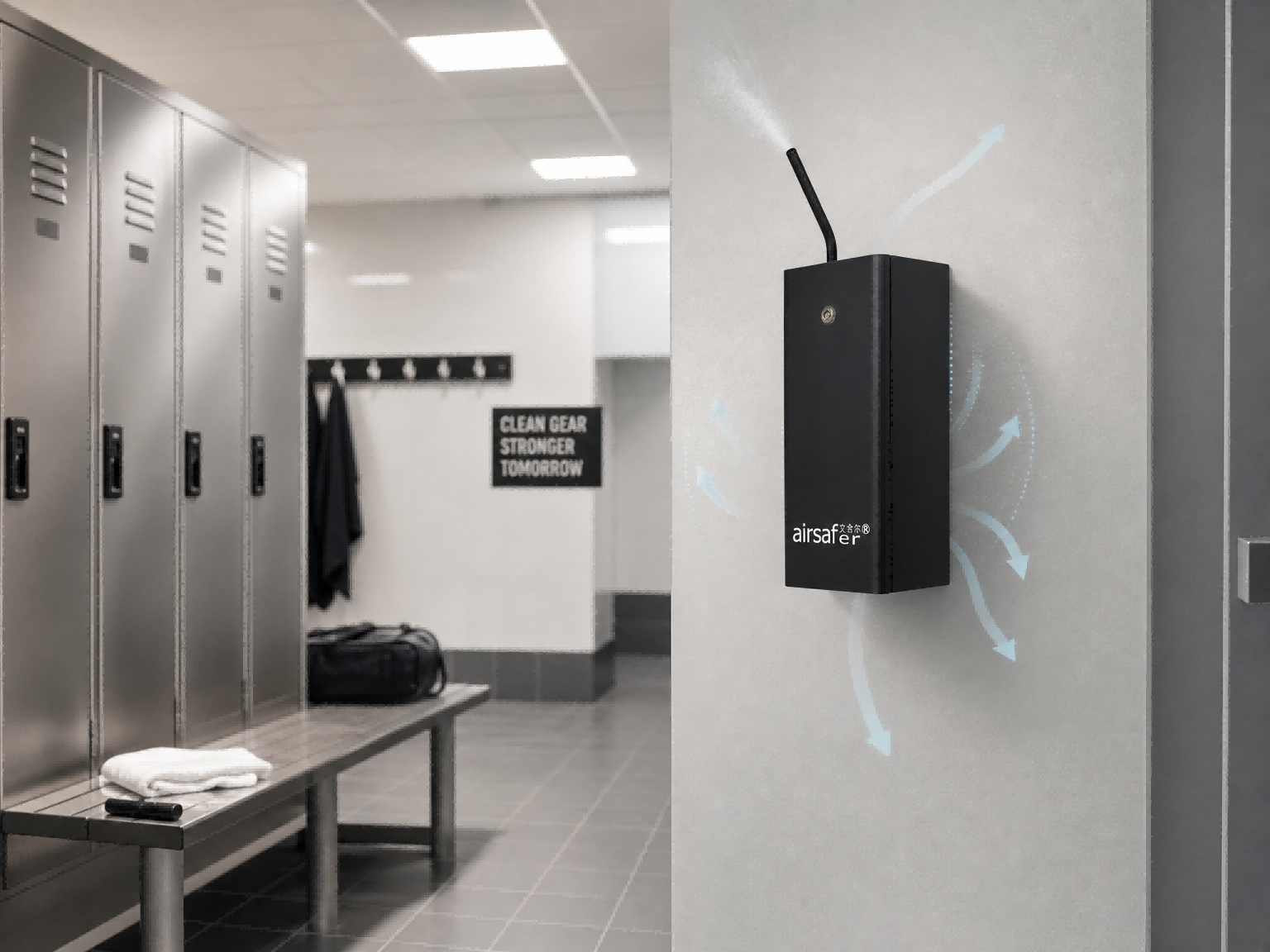
ASX Series Dry-Mist Deodorizing Systems are AirSafer’s core deodorizing product line. The system atomizes dry-mist deodorizing liquid into particles under 1 micron (μm) — small enough to float like a gas rather than settling as visible moisture. Active ingredients collide with airborne odor molecules and break them down chemically.
| Model | Atomizer Units | Coverage | Host Unit Power | Best For |
|---|---|---|---|---|
| ASX-01 | 1 | 30 m² | Low-power | Small locker rooms, single shower zones |
| ASX-03 | 3 | 90 m² | Low-power | Medium gyms, staff changing rooms |
| ASX-06 | 6 | 180 m² | 200W | Factory locker rooms, large facilities |
| ASX-09 | 9 | 270 m² | 200W | Stadiums, aquatic centers, multi-room |
For detailed specifications and deployment cases for the single-nozzle ASX-01, see ASX-01 Environmental Odor Control.
Key Technical Features:
- <1 μm dry mist: Particle diameter below 1 micron; diffuses like a gas without increasing humidity or wetting surfaces
- Noise <30 dB: Quieter than a whisper; doesn’t interfere with normal activities
- 24-hour four-group scheduling: Automatic intensity adjustment for peak and off-peak periods
- Dry-mist deodorizing liquid: Plant-based concentrate, non-toxic, 200 ml cartridge, plug-and-play replacement
Ultra-low power consumption: ASX-01 uses ~0.5 kWh per month; ASX-06 ~1 kWh; ASX-09 ~1.5 kWh — far below the cost of enhanced ventilation.
Real-world case: At Huaxing Optoelectronics, a semiconductor display manufacturer, the factory locker room had odor complaints that ventilation alone couldn’t fix. After installing an ASX-06 covering 180 m², employee feedback flipped from complaints to positive comments about “fresh, natural-smelling air” — because the system was decomposing ammonia and amine compounds, not masking them.
For broader industrial odor control beyond locker rooms, see the Industrial Odor Solution Guide..
Summary: Control humidity → ventilate → clean surfaces → ASX dry-mist treatment. Skip any step, and the mildew smell returns within days.
3. Odor Elimination for Commercial Showers and Drains
Shower and drain odors are different from general locker-room air quality. They originate at a point source — the drain trap — and require targeted intervention.
Why Drains Smell (Even with P-Traps)
Every shower drain has a P-trap: a U-shaped bend holding water to block sewer gases. Three things defeat it:
- Evaporation. In locker rooms unused for days — weekend closures, seasonal facilities — the water seal simply dries out, opening a direct path for hydrogen sulfide.
- Siphonage. Poorly vented drain lines create suction that pulls the water seal out of the trap.
- Biofilm bypass. Even a primed P-trap doesn’t block gases produced inside the trap itself. The trapped water becomes a biofilm reactor, continuously generating odor that diffuses through the seal.
Three-Tier Drain Odor Strategy
Tier 1 — Maintain the water seal. Pour a quart of water into every shower drain weekly during low-use periods. For facilities closed weekends, make this a Monday-morning standard. A teaspoon of mineral oil on top slows evaporation without blocking drainage.
Tier 2 — Antimicrobial Deodorizer poured directly into drains. This is the core of drain odor control. AirSafer Antimicrobial Deodorizer is a concentrated multi-purpose deodorizing liquid that can be diluted and poured directly into drains, acting on the P-trap and downstream pipes.
How it works:
- Broad-spectrum antimicrobial: Kills odor-producing bacteria in drain biofilm, cutting off hydrogen sulfide and amine generation at the source
- Penetrating decomposition: Liquid formulation penetrates the polysaccharide matrix of biofilm, disrupting colonies and extending maintenance intervals
- Odor neutralization: Not fragrance masking — chemical binding of volatile sulfur compounds and amines, rendering them odor-inactive
Application:
- Dilute Antimicrobial Deodorizer concentrate with water at 1:10 to 1:20 ratio (depending on contamination level)
- Pour slowly into each drain at day’s end, when showers are no longer in use
- Allow 8–12 hours of contact time without flushing
- Weekly maintenance for normal conditions; daily for severe odor periods
Tier 3 — Dry-mist air treatment above shower zones. In high-use locker rooms where biofilm regrows faster than weekly drain treatments, position ASX dry-mist nozzles above shower areas to continuously decompose residual odor molecules escaping from drains. The ASX-01 (single nozzle, 30 m² coverage) suffices for an entire shower zone.
Synergistic effect: Antimicrobial Deodorizer treats the pipe interior (source) + ASX dry-mist treats the air space (escape) — covering the complete chain from generation to diffusion.
When Drains Aren’t the Problem
Before spending on drain treatments, check:
- Shower curtains and mats: Vinyl curtains grow mold on the bottom 6 inches where they stay wet. Replace or machine-wash monthly.
- Grout and caulk: Cracked grout lets water seep behind tiles, creating hidden mold colonies. Re-caulk annually.
- Ceiling tiles above showers: Steam rises. If the ceiling isn’t moisture-rated, replace water-stained tiles immediately — they’re mold incubators above the breathing zone.
Bottom line: The core of drain odor control is P-trap maintenance + Antimicrobial Deodorizer pipe treatment + ASX dry-mist air coverage. All three, or the smell returns. For complementary restroom odor source control, see the Urinal and Toilet Care Guide..
4. ASX System Selection Guide
Locker rooms vary dramatically. A school gym with 200 students cycling through in 15-minute bursts has very different odor dynamics from a six-person corporate fitness center with steady light use over 12 hours.
Selection by Space Size
| Room Size | Recommended Model | Deployment Notes |
|---|---|---|
| Micro (<15 m²) | ASX-01 | Single nozzle covers 30 m²; sufficient for small locker rooms or dedicated shower zones |
| Small (15–30 m²) | ASX-01 | Covers 30 m²; for irregular shapes, consider ASX-03 for flexible nozzle positioning |
| Medium (30–90 m²) | ASX-03 | Three nozzles cover 90 m²; ideal for standard commercial gyms and corporate changing rooms |
| Large (90–180 m²) | ASX-06 | Six nozzles, 200W host; proven in factory locker rooms (Huaxing Optoelectronics) |
| Extra-large (>180 m²) | ASX-09 or multiple ASX-06 | Nine nozzles cover 270 m²; larger spaces use multi-zone deployment |
Selection by Odor Severity
| Severity | Typical Scenario | Approach |
|---|---|---|
| Level 1: Mild | Well-ventilated, low occupancy, daily cleaning | ASX-01 + weekly drain maintenance |
| Level 2: Moderate | Standard gym, 50–100 users/day, visible dampness | ASX-03 + Antimicrobial Deodorizer (twice weekly) + quarterly deep cleaning |
| Level 3: Severe | Factory locker rooms, aquatic centers, high-density | ASX-06 or ASX-09 + Antimicrobial Deodorizer (daily) + dehumidifier |
ASX Dry-Mist Deodorizing Liquid
The ASX system uses a single standardized consumable: dry-mist deodorizing liquid — plant-based concentrate, non-toxic, ready to use.
| Parameter | Specification |
|---|---|
| Composition | Natural plant extracts |
| Form | Oil-based concentrate, ready-to-use, no dilution required |
| Cartridge capacity | 200 ml |
| Replacement interval | 30–60 days per 200 ml (depending on spray intensity settings) |
| Safety | Non-toxic, non-irritating, non-hazardous |
| Applications | Universal — gyms, factories, schools, sports venues |
Rule of thumb: If the locker room smells fine empty but bad when occupied, ventilation is the issue — fix that first, with ASX coverage as supplement. If it smells bad even when empty, you have a moisture or mold problem — add dehumidification plus ASX treatment. If odor is concentrated near drains, go back to Chapter 3: Antimicrobial Deodorizer is the primary solution, with ASX dry-mist as air-space backup.
5. Antimicrobial Deodorizer + ASX Dry-Mist: Combined Deployment
For typical commercial locker rooms, the most effective deodorizing strategy isn’t a single product — it’s the combination of “pipe treatment + air coverage.”
How the Combination Works
Antimicrobial Deodorizer: Treats inside the pipe
    ↓ Kills biofilm odor-producing bacteria → cuts off H₂S/amine generation at source
    ↓ Penetrates and decomposes colony matrix → extends maintenance intervals

ASX Dry-Mist System: Treats the air space
    ↓ <1 μm dry mist suspends and diffuses → decomposes escaped odor molecules
    ↓ 24-hour scheduled operation → automatic boost during peak hours

    Two methods covering the complete chain from "generation" to "escape"
Standard Deployment Scenarios
| Locker Room Type | Area | Pipe Treatment | Air Treatment | Monthly Consumable Cost |
|---|---|---|---|---|
| Small staff changing room | ≤30 m² | Antimicrobial Deodorizer, weekly | ASX-01 ×1 | Low |
| Standard gym changing room | 30–90 m² | Antimicrobial Deodorizer, twice weekly | ASX-03 ×1 | Low-medium |
| Factory/school locker room | 90–180 m² | Antimicrobial Deodorizer, every other day | ASX-06 ×1 | Medium |
| Large venue changing area | 180–270 m² | Antimicrobial Deodorizer, daily | ASX-09 ×1 | Medium-high |
| Multi-room/zoned | >270 m² | Antimicrobial Deodorizer, daily per drain | Multiple ASX-06 or ASX-09 zone coverage | Configurable |
Antimicrobial Deodorizer Application Guide
Dilution Reference:
| Contamination Level | Dilution Ratio (concentrate:water) | Application Frequency |
|---|---|---|
| Mild (routine maintenance) | 1:20 | Weekly |
| Moderate (noticeable odor) | 1:15 | Twice weekly |
| Severe (persistent strong odor) | 1:10 | Daily for 3–5 days, then reduce to maintenance frequency |
Notes:
- Do not mix with other chemical cleaners (especially acids or strong alkalis)
- Pour at day’s end when showers are no longer in use; maintain 6–8 hours contact time without flushing
- For initial treatment of heavily contaminated drains, apply daily for 3–5 days until odor significantly decreases, then switch to routine maintenance
- Non-hazardous; standard shipping methods apply
6. Implementation Checklist and Maintenance Routine
Deploying a deodorizing system without a maintenance plan is like buying a car and never changing the oil. It works for a while.
Pre-Deployment Audit
Before installing anything:
- Measure room dimensions (L × W × H → m³) to size equipment correctly
- Count drains, showers, and toilets — each is a potential odor point source
- Map ventilation: locate supply and exhaust grilles; check dead zones by observing tissue movement
- Measure ambient humidity with a hygrometer (target: <60% RH) at multiple spots and times
- Inspect surfaces: grout condition, ceiling tiles, locker materials (porous vs. non-porous)
- Document peak usage times: shift changes, class periods, tournament schedules
- Identify available power sources near planned equipment locations
Deployment Timeline
Week 1 — Infrastructure
  Repair grout; replace water-damaged ceiling tiles
  Service HVAC: clean coils, replace filters, verify exhaust fan CFM
  Deep-treat all drains with Antimicrobial Deodorizer (1:10 concentration, overnight soak)
  Install dehumidifier if ambient RH consistently >60%

Week 2 — Active Treatment Installation
  Install ASX dry-mist nozzles and host units per coverage plan
  Run piping if deploying multi-nozzle systems
  Fill dry-mist deodorizing liquid; set timers to match peak occupancy windows

Week 3 — Calibration and Testing
  Adjust spray intervals and intensity per nozzle
  Walk the space at different times: empty (8am), mid-use (noon), post-peak (6pm)
  Gather informal feedback from regular users
Ongoing Maintenance
| Task | Frequency | Supplies Needed |
|---|---|---|
| Check ASX dry-mist deodorizing liquid level | Weekly | Spare dry-mist deodorizing liquid |
| Clean ASX nozzles | Monthly | Soft brush, warm water |
| Wipe ASX unit exteriors | Weekly | Microfiber cloth |
| Pour water into P-traps (low-use periods) | Weekly | Tap water |
| Antimicrobial Deodorizer drain treatment | 1–2× weekly (by severity) | Antimicrobial Deodorizer concentrate |
| Verify ASX timer settings (daylight saving, schedule changes) | Quarterly | — |
| Deep-clean grout and tile surfaces | Quarterly | Hydrogen peroxide cleaner (≥3%) |
| Replace ASX dry-mist deodorizing liquid | ~30–60 days / 200 ml | ASX dry-mist deodorizing liquid |
| HVAC filter replacement | Per manufacturer spec | MERV-8 or higher filters |
| Replace or wash shower curtains | Monthly / annually | — |
Measuring Results
Odor control is hard to quantify but easy to verify.
The CleanLink industry guide on locker room odor control notes that maintenance consistency is the single biggest variable. Even the best equipment underperforms if you skip cleaning schedules, leave mop buckets wet, or let damp towels sit overnight.
Track these metrics:
- Complaint frequency. The simplest KPI. If odor complaints hit zero within 30 days and stay there, the system is working.
- Humidity trends. Sustained RH below 55% means the mold growth cycle is broken.
- Consumable usage. Stable consumption means stable odor load. Rising consumption without rising occupancy suggests a new or growing odor source.
- Staff adherence. Spot-check that daily and weekly tasks actually get done, not just logged.
The real benchmark: walk into the locker room on a Monday morning after 48+ hours of low or zero occupancy. If the air smells neutral at 7 AM, the system is working at the source level.
When to Escalate
Some problems go beyond on-site equipment:
- Persistent odor despite full protocol: Suspect hidden mold behind walls or under flooring. Use a moisture meter on walls adjacent to showers; readings above 15% moisture warrant opening an inspection port.
- Sewer-gas odor despite P-trap maintenance: Possible vent stack blockage or cracked drain pipe. Call a licensed plumber for a smoke test.
- Musty odor from HVAC supply air: Mold in ductwork or on cooling coils. Requires professional HVAC cleaning — and investigation of why coils are staying wet (drain pan issue, oversized AC unit short-cycling).
Frequently Asked Questions
What causes musty smell in gym locker rooms?
Three factors combine to create persistent locker room odor: uncontrolled humidity (above 60% RH, mold spores germinate within 24–48 hours on organic surfaces), drain biofilm (bacteria colonies in P-traps continuously release hydrogen sulfide and amine gases), and poor ventilation (stagnant air pockets where odors concentrate). As covered in Chapter 1, masking these odors with fragrance is a temporary fix — true elimination requires humidity control, biofilm removal, and active air treatment.
How often should commercial locker room drains be treated?
For routine maintenance, treat drains weekly with Antimicrobial Deodorizer diluted at 1:20. For moderate odor (noticeable when entering the room), increase to twice weekly at 1:15. For severe cases, apply daily for 3–5 days at 1:10 concentration, then scale back. Always pour at day’s end and allow 6–8 hours contact time without flushing. See Chapter 3 for the full three-tier drain strategy.
How much does a commercial dry-mist deodorizing system cost?
Cost varies by coverage area and severity level. A single-nozzle ASX-01 covering 30 m² operates at ultra-low power (~0.5 kWh/month) with consumable replacement every 30–60 days. Medium spaces (90 m², ASX-03) run at similarly proportional combined power and consumable costs. Compared to the hidden cost of odor complaints — tenant dissatisfaction, staff turnover in factory settings, negative reviews — payback is typically measured in weeks. See the ASX Selection Guide for sizing by room dimensions and odor severity.
Is dry-mist deodorizer safe for enclosed spaces?
Yes. AirSafer’s ASX dry-mist deodorizing liquid is plant-based, non-toxic, and non-irritating. The atomized particles are under 1 micron — smaller than water mist, diffusing like a gas without wetting surfaces or increasing humidity. Noise output is below 30 dB (quieter than a whisper), making it suitable for continuously occupied spaces. For full safety and composition details, see Section 4 — ASX Dry-Mist Deodorizing Liquid.
Can I install the ASX system myself or do I need a professional?
ASX units are designed for plug-and-play installation. Wall-mount the host unit near a standard power outlet, position the atomizer nozzle(s) facing the treatment area, fill the deodorizing liquid cartridge, and set the 24-hour timer. Single-nozzle systems (ASX-01) typically take under 30 minutes. Multi-nozzle systems (ASX-06/09) may require simple piping between the host and satellite nozzles. No specialized HVAC or electrical work is needed. For guidance, refer to the deployment timeline in Chapter 6.
What’s the difference between antimicrobial deodorizer and dry-mist treatment?
Antimicrobial Deodorizer targets the source — poured directly into drains, it kills biofilm bacteria and chemically binds odor-causing sulfur and amine compounds inside the pipe. ASX dry-mist treats the air space — sub-micron particles float and collide with escaped odor molecules, decomposing them on contact. The two work in tandem: drain treatment cuts off generation, dry-mist catches what escapes. See Chapter 5 for the combined deployment strategy.
External References
- U.S. Environmental Protection Agency. Mold Remediation in Schools and Commercial Buildings: Chapter 1 — Introduction to Mold and Mold Remediation. https://www.epa.gov/mold/mold-remediation-schools-and-commercial-buildings-guide-chapter-1
- U.S. Environmental Protection Agency. Mold Remediation in Schools and Commercial Buildings: Chapter 4 — Structural Remediation. https://www.epa.gov/mold/mold-remediation-schools-and-commercial-buildings-guide-chapter-4
- CDC / NIOSH. Negative Pressure Ventilation in Healthcare and Athletic Facilities. https://stacks.cdc.gov/view/cdc/172513
- CleanLink. Odor Control in Locker Rooms. https://www.cleanlink.com/cleanlinkminute/details/Odor-Control-In-Locker-Rooms–25312