
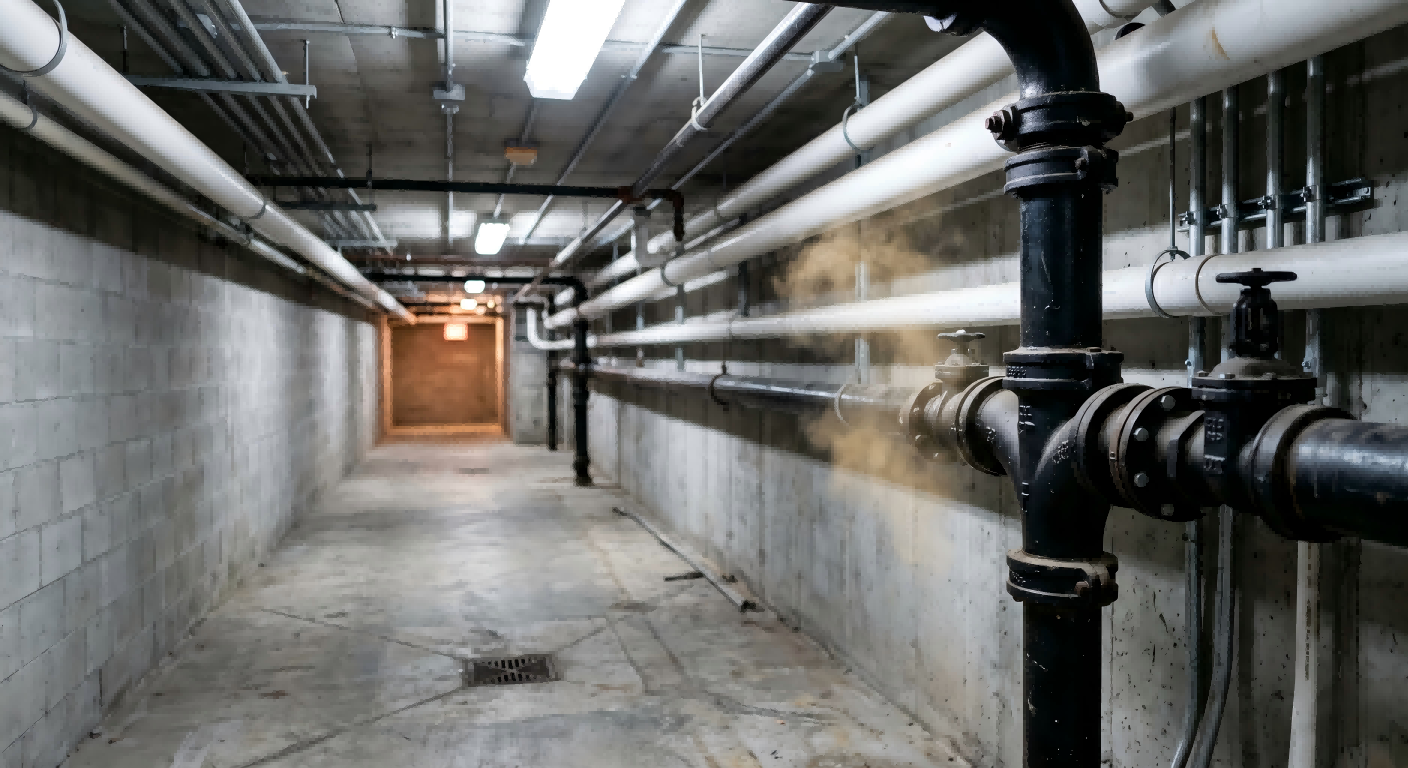
When a commercial building smells like sewer gas, people notice fast. Tenants complain. Staff start leaving doors open. Visitors assume the whole place is poorly maintained, even if the lobby looks spotless.
In most cases, that smell is not just “bad air.” It means gases from wastewater or drain systems are getting into occupied space through a failed water seal, a plumbing defect, or a drain system that keeps generating odor faster than the team can knock it down.
For facility managers, that changes the job. This is not a housekeeping issue you solve with a stronger fragrance. It is an operations problem with tenant, maintenance, and sometimes safety implications.
This guide explains how to get rid of sewer gas smell in commercial buildings using a practical B2B framework: find where the odor is getting in, cut it down at the source, treat the air people actually breathe, and turn the fix into routine maintenance. For broader context on industrial-scale odor strategy, see our industrial odor solution guide.
Table of Contents
- Why Sewer Gas Is a Facility Risk, Not Just a Nuisance
- Where Sewer Gas Enters a Commercial Building
- Why Conventional Fixes Often Fail
- A Two-Layer Sewer Odor Elimination Strategy
- ROI: What a Sewer Odor Problem Really Costs
- Deployment Scenarios by Building Type
- A 30-Day Action Plan for Facility Managers
- FAQ
Why Sewer Gas Is a Facility Risk, Not Just a Nuisance
A sewer-gas complaint usually starts with a simple description: rotten egg smell, drain odor, sewage smell, or an intermittent bad smell near restrooms, basements, parking structures, or service corridors. But in commercial settings, the consequences are larger than the smell itself.
Hydrogen sulfide (H2S), one of the most common contributors to sewer odor, is associated with eye irritation, respiratory discomfort, headaches, and nausea at low concentrations. At higher concentrations, it becomes a serious life-safety hazard. OSHA lists a ceiling concentration for hydrogen sulfide exposure, and NIOSH and CDC also note material health risks from elevated exposure in enclosed spaces. Methane, another sewer gas component, adds flammability and explosion concerns in poorly ventilated areas.
That is why sewer gas in a building should be treated as an operations risk. It can trigger:
- occupant complaints and negative visitor impressions
- tenant dissatisfaction and renewal risk
- staff discomfort and productivity loss
- escalated plumbing and maintenance costs
- corrosion risk for nearby infrastructure over time
- compliance and liability exposure if the cause is ignored
In hospitality, a sewer smell can damage ratings quickly. In offices, it creates the perception of poor building management. In food processing, warehousing, and institutional buildings, it can undermine hygiene confidence and create audit pressure.
The key point is simple: if people can smell sewer gas, the building already has an odor-control failure somewhere in the chain.
Where Sewer Gas Enters a Commercial Building
Before choosing a sewer odor eliminator or installing any system, facility teams need to understand the most common pathways that allow odor to escape.
1. Dry P-traps and low-use floor drains
P-traps are meant to block sewer gases with a standing water seal. In commercial buildings, low-use drains in stockrooms, vacant suites, mechanical rooms, floor drains, and seasonal restrooms can dry out surprisingly fast. Once the seal is gone, sewer gas has a direct path into the building.
2. Drain biofilm and organic buildup
Not every drain smell is caused by a failed trap. Many drains smell because a biofilm layer has built up inside the pipe wall. That biofilm continuously releases odor-causing sulfur compounds and amines. This is common in locker rooms, commercial restrooms, kitchens, and shower areas. For a related drain-focused facility article, see our commercial locker room odor control guide.
3. Blocked or poorly performing vent stacks
Vent stacks are designed to route gases safely out of the building. If they are blocked by debris, animal nesting, poor design, or negative-pressure interactions with rooftop HVAC intakes, sewer gases may be forced back into the occupied environment.
4. Failed toilet seals, wax rings, or pipe joints
In older buildings, a failed wax ring under a toilet, degraded gaskets, cracked pipe joints, or corroded connectors can create a chronic odor leak even when drains are used regularly.
5. Lift stations, ejector pits, and basement wastewater rooms
Commercial towers, hotels, hospitals, and mixed-use properties often have below-grade wastewater rooms, sewage ejector systems, or pump pits. These spaces can generate persistent hydrogen sulfide odors that migrate into service corridors, basements, or even upper floors if negative pressure and airflow are working against the building.
6. Nearby sewer infrastructure or manholes
Sometimes the odor source is not inside the room where people notice it. External sewer structures, manholes, grease systems, and collection points can release gases that move indoors through doors, vents, dock areas, or low-pressure zones.
A quick diagnostic checklist
If your team is trying to determine how to get rid of sewer gas smell efficiently, start with these questions:
- Is the odor strongest near a floor drain, restroom, or mechanical room?
- Does it get worse after weekends, vacancy, or low-occupancy periods?
- Does it intensify during HVAC operation or weather changes?
- Is the odor localized, or does it spread through corridors and return-air paths?
- Are plumbing fixtures, pits, or wastewater rooms nearby?
- Have recurring complaints continued despite cleaning?
These answers help separate a plumbing defect from an odor-generation problem. In many buildings, both exist at the same time.
Why Conventional Fixes Often Fail
Most buildings do not struggle with sewer odor because nobody saw the problem. They struggle because the first fix is usually too shallow.
“Just pour water down the drain”
Sometimes that works. If the only issue is a dry trap, water restores the seal and the smell stops.
But that is the easy case. If the real problem is recurring evaporation, drain biofilm, a vent issue, or an active wastewater source, the odor comes right back. Many facility teams learn this the annoying way: the smell disappears for a day, then returns on Monday morning.
Fragrance and masking products
Scented products do not remove sewer gases. They only compete with them for a few minutes. In commercial settings, that often backfires. People smell perfume mixed with sewage and assume maintenance is covering up a bigger issue.
Activated carbon only
Carbon can help in the right vent or duct application, but it is not a complete answer. Media saturates. Replacements get skipped. And none of that solves odor generation inside drains, pits, or wastewater collection points.
Surface cleaning only
Routine cleaning matters, but mopping and wipe-downs cannot reach the real problem when it sits inside a drain line, a P-trap, a pit, or a wastewater room.
The pattern is simple. Sewer odor has two layers:
- odor being generated inside the plumbing or wastewater system
- odor already loose in the air people are breathing
If a building treats only one layer, the complaint usually returns.
A Two-Layer Sewer Odor Elimination Strategy
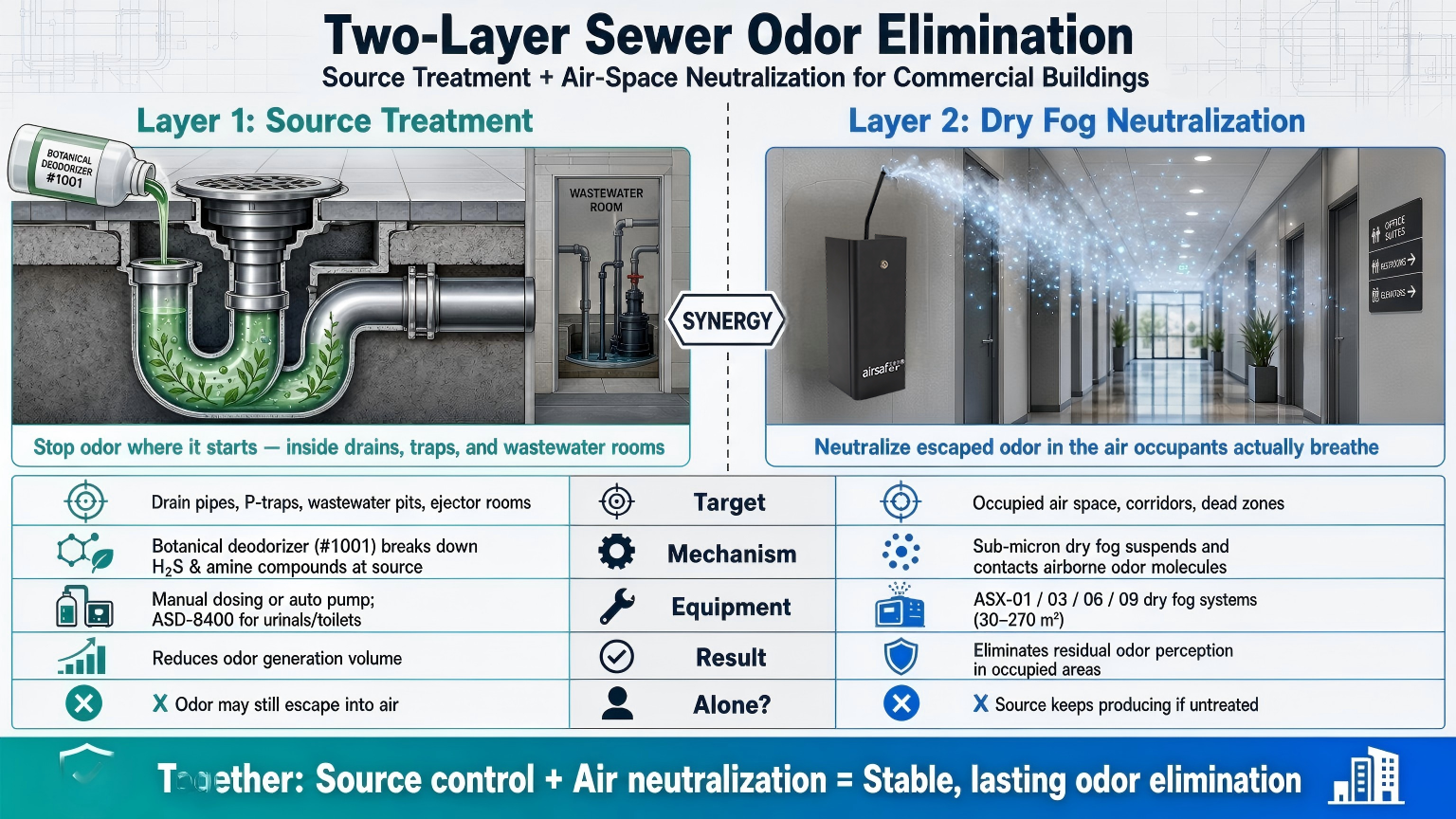
The most reliable B2B approach is straightforward: treat the source, then treat the air.
Layer 1: Control odor at the source inside drains and wastewater points
This is where the job starts. If the building keeps generating sewer odor, no air-side system will fully stabilize the space on its own.
For commercial drain zones, wastewater rooms, and sewage-related odor points, source treatment usually means:
- restoring water seals in low-use traps
- breaking down organic biofilm where drain odor keeps coming back
- applying deodorizing chemistry suited to sulfur- and amine-based odor compounds
- setting a maintenance schedule the staff can actually keep up with
AirSafer’s plant-based deodorizing chemistry can be matched to the application. For wastewater-related odor points, the wastewater-specific botanical deodorizer (#1001) is designed for ammonia and sulfur-bearing odor compounds. In drain-heavy or high-load zones, treatment can be done manually or through an automatic dosing setup suited to the actual plumbing environment.
For commercial restrooms, there is also a separate fixture-level option. The ASD-8400 drip dispenser is made for urinals and toilet tanks, where timed dosing helps control odor and improve maintenance consistency at the fixture itself. It is a restroom fixture solution, not a general pipe-network dosing device.
Where source treatment matters most
- commercial restrooms with recurring drain complaints
- locker rooms and shower zones
- basement pump or ejector rooms
- waste-holding or washdown areas
- food-service back-of-house drains
- low-use drains in large properties
The point of source treatment is to shrink the amount of odor the building produces in the first place.
Layer 2: Neutralize escaped sewer odor in the air space
Even with source treatment in place, some odor may still escape into occupied areas, especially in older buildings, high-load facilities, or spaces with tricky airflow.
That is where dry fog earns its keep.
AirSafer’s ASX series uses sub-micron dry fog to disperse deodorizing media through the air without soaking surfaces. Because the particles are extremely fine, the fog stays suspended longer and makes better contact with airborne odor molecules in awkward spaces. For the underlying particle-size principle, see our science of atomization.
Why dry fog works well for sewer odor problems
- it treats the air people actually notice
- it reaches dead zones where odor hangs around
- it can run continuously or on a schedule
- it helps cover the gap while source treatment brings the system back under control
- it suits occupied commercial environments when configured correctly
Model selection by area
The right model depends on the actual odor zone, not just the total building size.
- ASX-01: up to 30 m² for small odor rooms or localized zones
- ASX-03: around 90 m² for medium service rooms or corridor-linked areas
- ASX-06: around 180 m² for larger wastewater rooms or basement zones
- ASX-09: around 270 m² for broad industrial or high-load applications
Typical installation points
- wastewater rooms and basement service spaces
- restroom approach corridors where smell escapes from source rooms
- drain-dense utility areas
- garbage or washdown rooms adjacent to occupied spaces
- loading or service zones with external sewer odor migration
Why the two layers work together
Source treatment reduces generation. Dry fog manages what still escapes.
That combination matters because most commercial sewer-smell complaints are not caused by one isolated point failure. They are usually caused by a building system that leaks odor faster than cleaning staff can react. A two-layer strategy changes the response from reactive to controlled.
ROI: What a Sewer Odor Problem Really Costs
Many facilities underestimate the cost of persistent sewage odor because it is spread across departments.
Direct costs
- repeat janitorial interventions
- plumbing callouts and emergency inspections
- drain cleaning and reactive maintenance
- higher consumable spend on ineffective masking products
Indirect costs
- tenant complaints and management time
- negative reviews in hotels, retail, and mixed-use properties
- lower staff comfort and morale
- reputational damage during tours, audits, or leasing visits
- possible corrosion and long-term infrastructure damage in high-H2S environments
Why system-based control often pays back faster than expected
A structured sewer odor control plan helps facilities:
- reduce repeat complaints
- reduce emergency responses
- improve housekeeping consistency
- protect occupancy experience
- extend asset life in odor-prone service areas
For many commercial buildings, the question is not whether there is a cost to sewer odor. The real question is whether the building wants to keep paying it in small recurring losses.
Deployment Scenarios by Building Type
Hotel basement wastewater odor
Hotels often experience sewer-smell complaints when back-of-house wastewater or pump rooms sit below guest areas. In that case, the practical approach is source treatment in the wastewater room plus an ASX air-side deployment to stop odor migration into service corridors and adjacent occupied zones.
A medium-scale installation such as ASX-03 is often appropriate where the odor zone is localized but recurring.
Office tower with low-use drains and restroom complaints
In office properties, odor often appears after weekends or partial occupancy. Dry traps may be part of the issue, but recurring complaints usually indicate a deeper maintenance gap. The solution is a trap-refill schedule, drain-source treatment where biofilm is present, restroom fixture management where appropriate, and dry-fog coverage for persistent transition zones.
Food-processing or commercial kitchen support areas
In buildings with organic loading, frequent washdown, and drain-heavy operations, odor generation can exceed what ordinary cleaning can manage. These sites often benefit from more aggressive source treatment and larger-area ASX deployment, especially if the smell is affecting adjacent circulation or work zones. For plant-wide context, see our wastewater treatment odor eradication guide.
Shopping malls, transit hubs, and public restrooms
High-traffic facilities often need a layered public-restroom strategy. Fixture-level dosing can support urinals and toilets, while drain and air-space treatment handle the larger odor field. This is where separating fixture odor, drain odor, and room-air odor becomes important.
A 30-Day Action Plan for Facility Managers
If you need a practical framework for how to get rid of sewer gas smell in a commercial building, this is a workable first month.
Week 1: Diagnose and map the odor
- identify complaint hotspots and time patterns
- inspect low-use drains and verify trap seals
- review vent-stack, pit, and wastewater-room locations
- distinguish restroom fixture odor from drain and sewer-gas odor
- note any HVAC or pressure relationships that worsen migration
Week 2: Stabilize obvious source failures
- refill dry traps and create a schedule for low-use drains
- deep-treat drains with biofilm or recurring sulfur smell
- inspect toilets, wax rings, and drain connections where leaks are suspected
- begin wastewater-point deodorizer treatment where needed
Week 3: Add air-space protection
- deploy ASX dry fog in persistent odor zones
- set operating schedules around occupancy and complaint peaks
- verify that the system is treating the odor zone, not just the room center
Week 4: Review results and standardize
- compare complaint frequency before and after intervention
- adjust dosing frequency and fog schedule
- document building-specific odor routes
- convert the response into routine PM rather than emergency cleanup
That last step is important. Sewer odor control becomes much more cost-effective once it is managed as preventive maintenance instead of episodic troubleshooting.
FAQ
Can sewer gas make employees or tenants sick?
At meaningful concentrations, yes. Hydrogen sulfide can cause irritation, headaches, nausea, and respiratory discomfort, and high concentrations are dangerous. If odor is strong, persistent, or concentrated in enclosed spaces, building teams should treat it seriously and escalate inspection as needed.
How do I know whether the smell is sewer gas or mold?
Sewer gas usually presents as rotten egg, sulfur, or sewage odor and is often strongest near drains, pits, toilets, or wastewater areas. Mold odors are typically musty and linked to damp materials, wall cavities, or HVAC moisture problems. In some facilities, both conditions exist at once.
Is dry fog safe for occupied commercial spaces?
Dry fog systems designed for deodorizing occupied spaces can be used safely when configured correctly with the proper media, placement, and schedule. The important point is that the treatment plan should match the environment and the chemistry being dispersed.
How often should drain or wastewater source treatment be applied?
That depends on odor severity, organic loading, drainage design, and occupancy. High-load sites may require frequent or automated treatment, while lighter-use buildings may only need periodic maintenance. The right interval is determined by odor recurrence, not guesswork.
What if the odor comes from the municipal sewer line or an external manhole?
That can happen. In those cases, indoor treatment still matters, but the building should also evaluate external entry points, pressure pathways, and any infrastructure coordination required outside the property line.
Final Thoughts
The best answer to how to get rid of sewer gas smell in a commercial building is not a stronger fragrance or a one-time drain treatment. It is a building-systems approach.
First, stop the odor from being generated or released at the source. Then treat the air space where people actually experience the problem. Finally, turn the response into a repeatable maintenance standard.
That is how facilities move from recurring complaints to stable control.
If your site is dealing with persistent sewage odor, drain-gas complaints, or wastewater-room odor migration, AirSafer’s combination of source-side deodorizing chemistry and ASX dry fog treatment provides a more complete path than masking alone.