
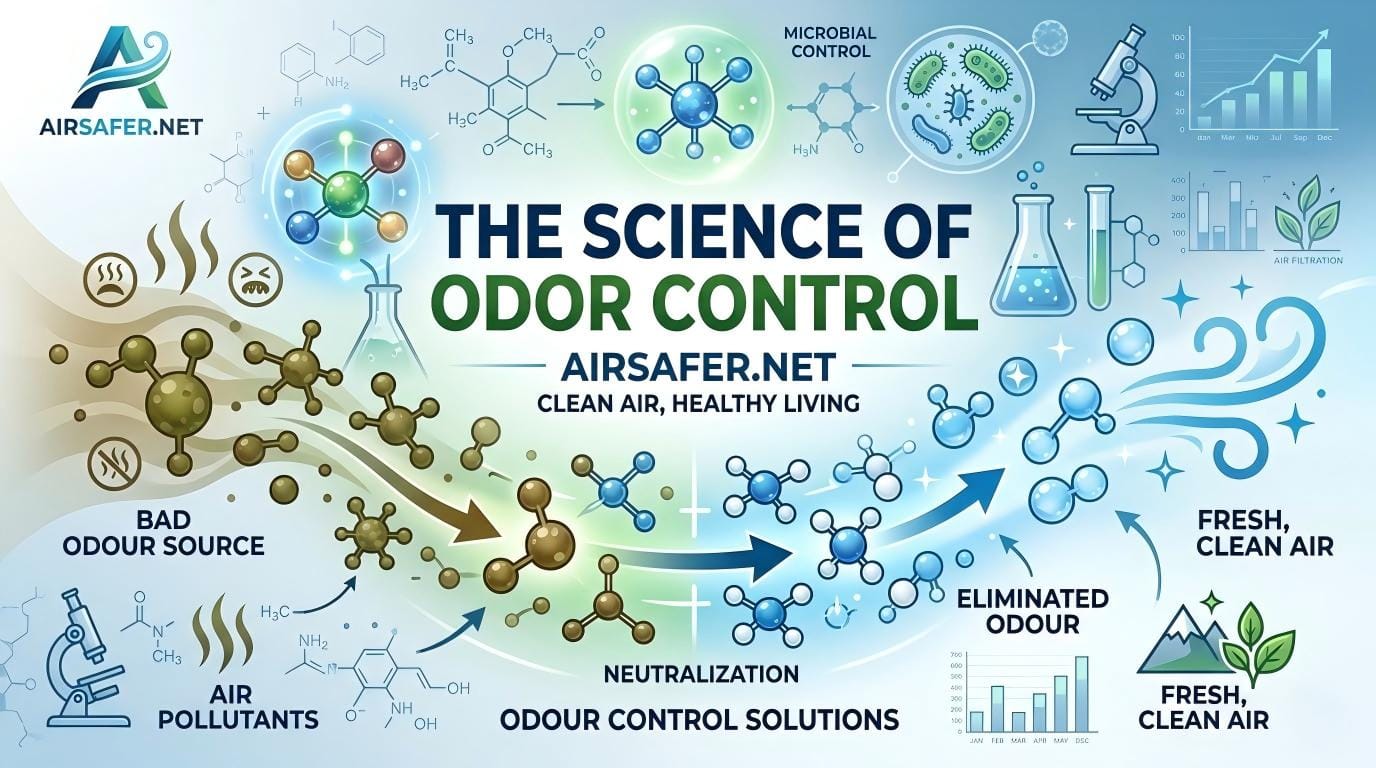
Odor control gets talked about like a cosmetic issue. Most of the time, it is really a chemistry problem with an air-distribution problem sitting right beside it. Bad smells come from volatile compounds released into the air. Those compounds move with humidity, surfaces, airflow, and temperature, and they keep circulating until something actually removes, breaks down, or traps them. That is why fragrance alone rarely fixes the issue for long.
Real odor elimination depends on fit. The right solution has to match the compounds involved, the airflow pattern in the space, and the amount of coverage the site actually needs. In some places, adsorption and filtration make sense. In others, oxidation chemistry, biofiltration, bipolar ionization, or dry fog systems are a better match.
AirSafer documents several technical routes for odor control: two-fluid industrial dry fog systems, an ultra-fine dry fog system with particle size below 1 μm in the ASX-06 configuration, and an ion-based purification route using bipolar ionization to generate reactive species that participate in odor compound oxidation.
Why Masking Smells is Not a Solution: The Chemistry of Odor
A lot of odor complaints get treated with the fastest visible fix: perfume, deodorizing scent, or a stronger fragrance layered over the original smell. The trouble is that this only changes perception for a while. If the source compounds are still there, the odor usually comes back once the masking agent fades.
What Are Odors? Understanding Volatile Organic Compounds (VOCs)
Odors come from airborne molecules that reach the olfactory system at detectable concentrations. Many are volatile organic compounds, or VOCs, but odor can also come from inorganic gases such as hydrogen sulfide (H₂S) and ammonia (NH₃). In industrial and commercial settings, odor events often involve mixtures of sulfur compounds, nitrogen compounds, aldehydes, fatty acids, ketones, and solvent-like VOCs.
What matters is not just that something smells. It is how those molecules behave once they are in the air. Some diffuse quickly. Some cling to porous surfaces. Some dissolve into thin moisture films and then release back into the room later. Others are generated continuously by waste, wastewater, biological activity, or human occupancy. That is why odor control has to focus on molecular removal or transformation rather than sensory distraction.

The Masking Trap: Why Fragrances Make the Problem Worse
Fragrance-based products can make a space seem fresher, but they do not necessarily lower the concentration of odor-causing compounds. In some cases, they make the air messier by adding more chemicals to a space that is already contaminated. The result is not real relief so much as a mix of perfume and malodor.
In professional facilities, that matters for more than comfort. Persistent odor shapes visitor perception, affects worker satisfaction, signals poor cleanliness, and can trigger compliance conversations when neighbors or occupants read smell as evidence of weak environmental control. A room that smells “better” for ten minutes and then rebounds is not under control.
The “Heavier Air” Phenomenon Explained
People often describe bad odors as if they “sit low” or “hang in the air.” Usually that comes from distribution effects, not from a simple idea that smell is literally heavier than clean air. Odor compounds interact with temperature gradients, stagnant zones, humidity, and poor mixing. In enclosed spaces, treatment that does not distribute well can leave pockets of untreated air where odor lingers and then spreads again.
That helps explain the interest in ultra-fine fog and active air-treatment technologies. If treatment particles or reactive species can move more evenly through the room volume, they have a better chance of contacting odor molecules before those compounds settle onto surfaces or keep recirculating.
The Cost of Temporary Solutions
Temporary odor masking can look cheap at first. In practice, it tends to turn into a recurring operating cost. Staff use more product. Complaints keep coming. Facilities end up depending on repeated manual intervention. In industrial settings, temporary control can also mean repeated nuisance episodes, avoidable downtime around odor events, and the same explanations over and over about why the smell is back.
The bigger issue is strategic. A facility may think it has an odor-control plan when what it really has is a scent routine.
Three Scientific Approaches to True Odor Elimination
Most effective odor control falls into three broad categories: physical removal, chemical neutralization, and biological degradation. In real facilities, systems often combine more than one of these.
Physical Methods: Adsorption and Filtration
Physical methods are meant to capture, retain, or separate odor-causing compounds from the air stream. They do not always change the compounds chemically, but they can bring down airborne concentration when the system is designed correctly.
Activated Carbon: How It Traps Molecules
Activated carbon works through adsorption, not absorption. Its porous structure creates a huge internal surface area where gas molecules can attach. That makes it effective for certain VOCs and other odorous compounds, especially when concentrations are moderate and airflow is controlled.
Its main limitation is saturation. Once the adsorption sites fill up, performance falls off and the media has to be replaced. Carbon can work very well in contained systems, but it is not always the most economical answer for large open odor zones or fluctuating industrial emissions.
HEPA vs. Odor: Why Particle Filtration Isn’t Enough
HEPA filters are excellent at capturing airborne particles, including dust, aerosols, and some biological contaminants. But odor is often driven by gases and vapor-phase molecules that move right past particle filters. A room can be visibly clean and still smell bad.
That distinction matters in controlled environments and nearby support spaces. Facilities sometimes assume that strong particulate filtration automatically means odor control. It does not. Odor control usually needs gas-phase treatment, oxidation, adsorption media, or another targeted approach in addition to particle filtration. For a cleanroom-focused discussion of that gap, see the guide to cleanroom locker room odor control.
Chemical Methods: Molecular Neutralization
Chemical methods work by turning odor-causing molecules into less odorous or non-odorous forms. In many cases, this is the clearest path to real elimination because the original compound is no longer present in the same chemical state.
Oxidation Reactions: Breaking Down VOCs
Oxidation is one of the most common odor-neutralization mechanisms in industrial and commercial systems. Reactive species interact with odor compounds and break chemical bonds, converting them into simpler or less offensive substances. Depending on the system, that may involve oxidants generated in air, catalytic processes, or reactive radicals formed during treatment.
AirSafer’s ion-based purification route uses high-voltage bipolar ionization. The system forms positive and negative oxygen ions from oxygen molecules and water vapor in the air, and further generates reactive oxygen species including hydroxyl radicals. These reactive species participate in the oxidation and degradation of malodorous compounds such as VOCs, methyl mercaptan, hydrogen sulfide, and ammonia, and the system can be integrated with AHU/HVAC ducting or installed as a standalone wall-mounted unit.
Encapsulation: The Cyclodextrin Approach
Not all chemical odor control works through oxidation. Some approaches use molecular encapsulation. Cyclodextrins, for example, are ring-shaped molecules that can trap certain odor compounds inside a cavity-like structure. That does not always destroy the odor molecule, but it can reduce volatility and lower perceived intensity.
Encapsulation can be useful in consumer and light commercial applications, especially where harsher oxidants are not desirable. Still, performance depends heavily on the chemistry of the odor compound and on whether the treatment agent actually gets enough contact with it.
Biological Methods: Biofiltration and Enzymes
Biological odor control relies on living microorganisms or enzyme-assisted processes to break down odor-causing compounds. Biofilters, biotrickling filters, and related systems are common in wastewater, composting, and other large-scale environmental applications where air streams are relatively stable and continuous.
Biological methods can work efficiently for certain compound classes over long operating periods. The tradeoff is practical rather than glamorous: they usually need environmental stability, media management, moisture control, and enough residence time. They are not always a good fit for intermittent indoor odor bursts or spaces that need a quick response.
Advanced Physical: Nano Dry Fog Technology (AirSafer Differentiation)
Dry fog sits in an interesting middle ground between air distribution and chemistry. The goal is to produce droplets fine enough to stay suspended long enough to contact odor molecules throughout the target space without wetting surfaces.
AirSafer offers two dry fog approaches. The AQE series is an industrial-grade two-fluid spray odor-control system using air atomization dry fog technology to generate 2–6 micron droplets. It integrates a built-in 375W air compressor, supports 3–9 nozzle configurations, and covers approximately 75–225 m² depending on configuration. The ASX-06, by contrast, is a six-atomizer dry fog system covering 180 m² with particle size below 1 μm, 200W power, noise below 30 dB, and ultra-low-pressure, ultra-low-flow control.
What is Dry Fog? Particle Size and Surface Area Science
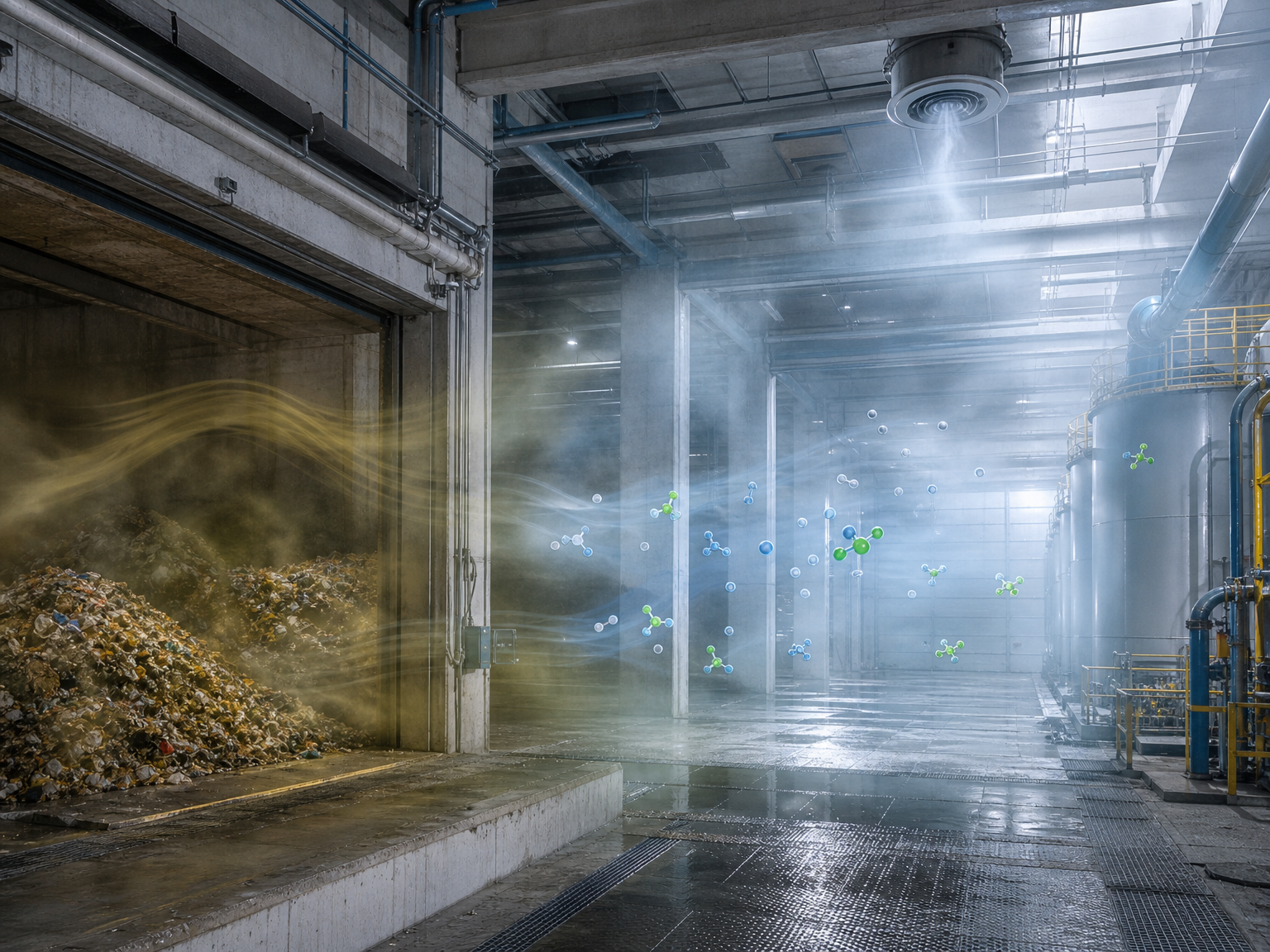
Dry fog is a mist made of droplets small enough to stay suspended and spread through the air volume instead of quickly settling as visible wet spray. The smaller the droplets, the greater the total surface area available for interaction with airborne odor molecules. In odor neutralization, that matters because contact efficiency matters.
Larger droplets may fall onto surfaces before they treat the room volume effectively. Very fine droplets can travel with air currents, reach stagnant zones more easily, and create more distributed contact with odor compounds. When paired with an appropriate deodorizing agent, that can improve coverage consistency.
The 1-Micron Advantage: Why Smaller Droplets Work Better
AirSafer’s technical documentation for the ASX-06 reports a certified mean particle diameter below 1 μm. At this scale, the fog behaves like a gas in room distribution, helping it fill enclosed volume without obvious stratifying or settling. That room-distribution behavior is the key scientific advantage of ultra-fine dry fog. Readers who want a product-level example can compare it with the ASX-01 environmental odor control system, while those who want the underlying spray-generation principles can continue to the science of atomization.
Smaller droplets do not solve every odor problem by themselves, but they can increase the chance of room-wide contact when the application needs uniform coverage instead of point-source spraying alone. That makes ultra-fine dry fog especially relevant in enclosed or semi-enclosed odor-control scenarios where untreated air pockets keep showing up.
Odor Control Technologies Compared
No single odor-control technology wins in every setting. The right choice depends on emission type, room geometry, airflow, moisture, maintenance tolerance, and whether the problem is continuous, intermittent, local, or facility-wide.
Technology Comparison Table
| Technology | Primary Mechanism | Best Use Case | Strengths | Limitations |
|---|---|---|---|---|
| Activated carbon | Adsorption | Ducted air, contained gas-phase polishing | Effective for many VOCs, well understood | Media saturates and requires replacement |
| HEPA filtration | Particle capture | Dust-sensitive and clean environments | Excellent for particulates | Not sufficient for odor gases alone |
| Oxidation chemistry | Molecular breakdown | VOCs and reactive odor compounds | Can eliminate rather than mask | Requires chemistry matched to application |
| Cyclodextrin encapsulation | Molecular inclusion | Light commercial and consumer odor reduction | Gentle and useful in some occupied spaces | Not universal for all compounds |
| Biofiltration | Biological degradation | Large continuous environmental air streams | Strong for steady industrial emissions | Space, moisture, and residence-time dependent |
| Bipolar ionization | Reactive species generation | HVAC-integrated or standalone air treatment | Active air treatment, broad odor relevance | Performance depends on installation and air distribution |
| Two-fluid dry fog | Fine droplet distribution | High-volume industrial odor control | Good area coverage, industrial practicality | Droplet size larger than ultra-fine submicron fog |
| Ultra-fine dry fog | Submicron suspended treatment fog | Precision enclosed-volume odor control | Uniform room-volume distribution potential | Requires proper formulation and placement |
When to Choose Which Approach
Selection should start with a plain engineering question: are you trying to trap the odor, transform it, biologically degrade it, or distribute treatment through the full air volume? In many facilities, the answer is some combination.
High-Volume Industrial: Two-Fluid Atomization
For high-volume industrial environments, two-fluid atomization is often attractive because it can cover larger working zones while keeping dry fog characteristics. The AQE series is designed for industrial-grade odor control, uses air atomization dry fog technology with 2–6 micron droplets, includes a built-in 375W air compressor, and is suitable for locations such as waste transfer stations, industrial plants, HVAC systems, large public restrooms, and cleanroom changing areas. For a broader framework on facility-level selection, see this industrial odor control guide.
That makes two-fluid dry fog a strong option where robustness, multi-nozzle coverage, and industrial deployment flexibility matter more than submicron precision.
Commercial Spaces: Ion Purification Systems
In commercial spaces, especially those already served by central ventilation, ion-based purification can be appealing because treatment can be integrated into existing AHU/HVAC infrastructure. AirSafer’s bipolar ionization system supports AHU/HVAC duct integration as well as standalone wall-mounted installation.
That deployment model can work well where odor moves through return air, occupancy shifts throughout the day, and direct fogging is not the preferred first step.
Precision Applications: Nano Dry Fog
Where uniform enclosed-space distribution matters most, ultra-fine dry fog offers a clear advantage. The ASX-06 configuration combines below-1 μm particle size with ultra-low-pressure, ultra-low-flow control and low operating noise. That makes it especially relevant in precision applications where wetting, stratification, and uneven room treatment are real concerns. A related published example is the ASX-01 odor control case example.
Targeting Specific Odor Compounds
The chemistry of the odor source determines the control strategy. A system that performs well on sulfur compounds may behave differently with ammonia or mixed VOC streams.
Hydrogen Sulfide (H₂S): The Rotten Egg Challenge
Hydrogen sulfide is one of the most recognizable industrial odor compounds. It has a strong rotten-egg smell, a very low odor threshold, and frequent links to wastewater, waste handling, sludge, and decomposition processes. Even at low concentrations, it can trigger serious nuisance complaints.
Common Sources: Waste Transfer Stations, Wastewater Plants
Waste transfer stations and wastewater treatment facilities commonly generate sulfur-containing odors, especially where organic matter accumulates, ferments, or decomposes under oxygen-limited conditions. Because H₂S is noticeable at very low odor thresholds, facilities need fast and reliable control, not occasional masking. For field-specific context, compare this look at odor control in MSW transfer stations with this guide to odor control in wastewater treatment.
AirSafer’s ion-based purification route explicitly lists hydrogen sulfide among the malodorous compounds that reactive oxygen species can participate in oxidizing. For broader area treatment, AirSafer’s AQE and ASX-06 dry fog systems also align with waste and wastewater-related application environments.
Ammonia (NH₃): The Restroom Problem
Ammonia has a sharp, irritating odor commonly associated with restrooms, missed cleaning, and some industrial or waste-related environments. It becomes especially frustrating when cleaning removes visible residue but leaves behind airborne or surface-bound contributors that keep volatilizing.
High-Traffic Commercial Bathrooms
High-traffic commercial bathrooms create a recurring odor problem because source generation is frequent, humidity changes, and airflow is often uneven. In these spaces, facility teams often compensate by overusing fragrance products, which can make the sensory clutter worse without removing the source compounds.
AirSafer’s bipolar ionization system lists ammonia among the targeted malodorous compounds involved in oxidation processes. For smaller closed spaces, the ASF-001 digital spray machine is an entry-level device developed for point deodorization in areas of about 10–15 m², including bathrooms, changing rooms, and hotel rooms. In practical terms, it fits best as a small-space point solution for restroom-related odor control rather than an industrial VOC control system.
Complex VOC Mixtures: Industrial Environments
Industrial environments often produce mixed odor profiles rather than neat single-compound events. Solvent notes, sulfur compounds, process emissions, organic vapors, and warm-air recirculation can combine into a layered odor signature that changes through the day.
That is where technology matching becomes important. Carbon may help with part of the gas-phase load. Oxidative systems may help transform reactive compounds. Dry fog systems may improve treatment distribution through the target volume. The best design often comes from combining source knowledge with spatial treatment strategy.
How Nano Dry Fog Neutralizes Each Compound Type
Nano-level or ultra-fine dry fog does not neutralize every odor molecule just because the droplets are small. Its real scientific advantage is distribution and contact. By producing extremely fine suspended droplets, it increases the likelihood that the active deodorizing formulation will encounter sulfur compounds, ammonia-related odors, and complex VOC mixtures throughout the room volume instead of only along a narrow spray path.
For the ASX-06, particle size below 1 μm and gas-like room distribution are the key facts that support this positioning. The exact neutralization pathway still depends on the formulation being dispersed, so the honest technical claim is better coverage and contact opportunity, not a blanket promise of identical chemistry for every compound.
Application Scenarios: Matching Technology to Environment
Odor control works best when the technology fits the physical and operational reality of the site.
Waste Transfer Stations and Landfills
Waste transfer stations and landfill-adjacent facilities generate variable, intense, and often open-zone odors. Those conditions favor robust industrial systems with meaningful coverage and practical nozzle deployment. AirSafer’s AQE series fits that profile as an industrial-grade two-fluid dry fog system intended for large-area odor control. A relevant application example is this article on MSW transfer station odor control.
Wastewater Treatment Facilities
Wastewater facilities often deal with sulfur compounds, ammonia, and biologically generated mixed odors. Depending on the process area, suitable strategies may include oxidation-based treatment, biofiltration, or distributed fogging systems. AirSafer’s ion-based purification and dry fog product lines both align with this general environment. For a dedicated application page, see this guide to wastewater odor treatment strategies.
Commercial Restrooms and Elevators
Commercial restrooms and elevators are enclosed spaces where odor is noticed immediately and occupant tolerance is low. Small-space deodorization devices may be useful in tightly defined areas, while HVAC-integrated ion treatment can support broader air-circulation control in larger buildings. In these settings, the wrong move is usually over-fragrancing instead of source-focused control.
Industrial Manufacturing Plants
Manufacturing plants may have process-specific VOCs, solvent-like emissions, or mixed nuisance odors. A one-size-fits-all consumer product is rarely enough. Facilities usually need a technology decision based on source type, air volume, and whether the problem is local, line-based, or building-wide. Industrial dry fog and active air-treatment systems usually make more sense here than fragrance dispensers.
Cleanroom and Controlled Environments
Controlled environments need special attention because particulate cleanliness does not automatically mean odor control. Air handling, occupant comfort, and low-residue operation all matter. AirSafer’s AQE product line includes cleanroom changing rooms among suitable applications, which supports careful positioning of dry fog systems where room-distribution performance matters and wetting must be avoided. Readers looking for the cleanroom-specific angle can continue to this cleanroom odor control guide.
The Science of Measurement: How We Know It Works
Odor control should be measured, not guessed at. Human complaints matter, but professional programs also use structured methods to evaluate odor intensity, concentration, and treatment performance.
EN 13725: The European Odor Measurement Standard
EN 13725 is a widely recognized European standard for odor measurement based on dynamic olfactometry. It provides a framework for quantifying odor concentration using human panels under controlled conditions.
This standard is useful in odor-science discussions because it separates measurable odor assessment from casual sensory impressions. It should still be referenced carefully. It is fair to describe EN 13725 as a general industry standard for odor measurement. It should not be presented as proof that any specific AirSafer product has been tested or certified under EN 13725 unless that documentation is explicitly available.
Olfactometry vs. Chemical Sensors
Olfactometry and chemical sensors answer different questions. Olfactometry measures perceived odor through human response. Chemical sensors measure specific compounds or classes of compounds. A sensor may detect hydrogen sulfide concentration, for example, while a human panel is better suited to capturing the combined nuisance impression of a mixed odor stream.
The most credible odor-control evaluations usually use both perspectives: chemistry for source understanding and perception-based methods for real-world impact.
ROI Metrics: From Compliance to Employee Satisfaction
Return on investment in odor control is rarely just about direct chemical reduction. It can also include fewer complaints, steadier operations, cleaner brand perception, better working conditions, and less friction with neighboring stakeholders. The exact ROI framework depends on the facility.
Because ROI is highly site-specific, responsible technical writing should avoid invented percentages or unsupported payback claims. It is more credible to describe ROI categories than to pretend there is numerical certainty where none has been documented.
People Also Ask: Your Odor Control Questions Answered
Why do odors come back after using air fresheners?
Air fresheners mask perception. They do not remove the compounds causing the smell. Once the fragrance fades, those molecules are still there—and the odor returns.
What is the difference between dry fog and traditional spray systems?
Droplet size. Traditional sprays produce larger droplets that settle onto surfaces quickly. Dry fog generates much finer droplets—often below 10 μm—that stay suspended longer, cover more air volume, and cause less surface wetting.
How does nano-level dry fog actually work at the molecular level?
It is not mystery chemistry. It is contact efficiency. Submicron droplets create an enormous total surface area and distribute more evenly through the room, giving the deodorizing formulation a better chance of actually meeting odor molecules before they settle or recirculate.
Do air purifiers eliminate odors or just cover them up?
Depends on the type. Particulate-only filters (HEPA, electrostatic) do very little for gas-phase odor molecules. Systems with gas-phase media, oxidation chemistry, or ion-based treatment can actively reduce odor concentration rather than mask it.
How do I choose the right odor control system for my facility?
Start with the source compound. Is it sulfur, ammonia, mixed VOCs, or biological off-gas? Then factor in the air volume, whether the problem is continuous or intermittent, and what maintenance commitment is realistic. That narrows the technology list fast.
What makes industrial-grade odor control different from consumer products?
Coverage, chemistry, and consistency. Industrial systems are engineered to treat air volumes measured in hundreds or thousands of cubic meters, run continuously, and target specific compound classes. Consumer products prioritize short-term sensory improvement in a small room.
Conclusion: Investing in True Air Quality
The basic science of odor control is straightforward: bad smells persist because the molecules causing them persist. Lasting results come from trapping, transforming, biologically degrading, or distributing treatment evenly enough to reach the full air volume—not from overpowering those molecules with fragrance.
AirSafer’s technology routes illustrate how different environments call for different tools:
- AQE series — industrial two-fluid dry fog, 2–6 μm droplets, multi-nozzle area coverage for large facilities.
- ASX-06 — below-1 μm ultra-fine dry fog designed for broad enclosed-volume distribution.
- Bipolar ionization — oxidation-oriented pathway where reactive oxygen species degrade VOCs, H₂S, and ammonia.
Each route solves a different operational problem. Choosing between them starts with understanding the compound, the space, and the coverage requirement.
From Science to Solution: Your Next Steps
If your facility still relies on masking fragrances, here is a practical starting point:
- Identify the source compound — sulfur, ammonia, mixed VOCs, or biological off-gas.
- Map the distribution — is the odor localized, room-wide, duct-borne, or site-wide?
- Match the technology — adsorption, oxidation, biofiltration, or distributed dry fog.
- Size the system — coverage area, nozzle count, airflow integration.
Need help matching a technology route to your specific environment? Explore the full industrial odor control guide or learn how atomization science drives system design.
True odor control starts when air quality is treated as a science problem instead of a perfume problem.
Get a Custom Odor Control Solution Today