

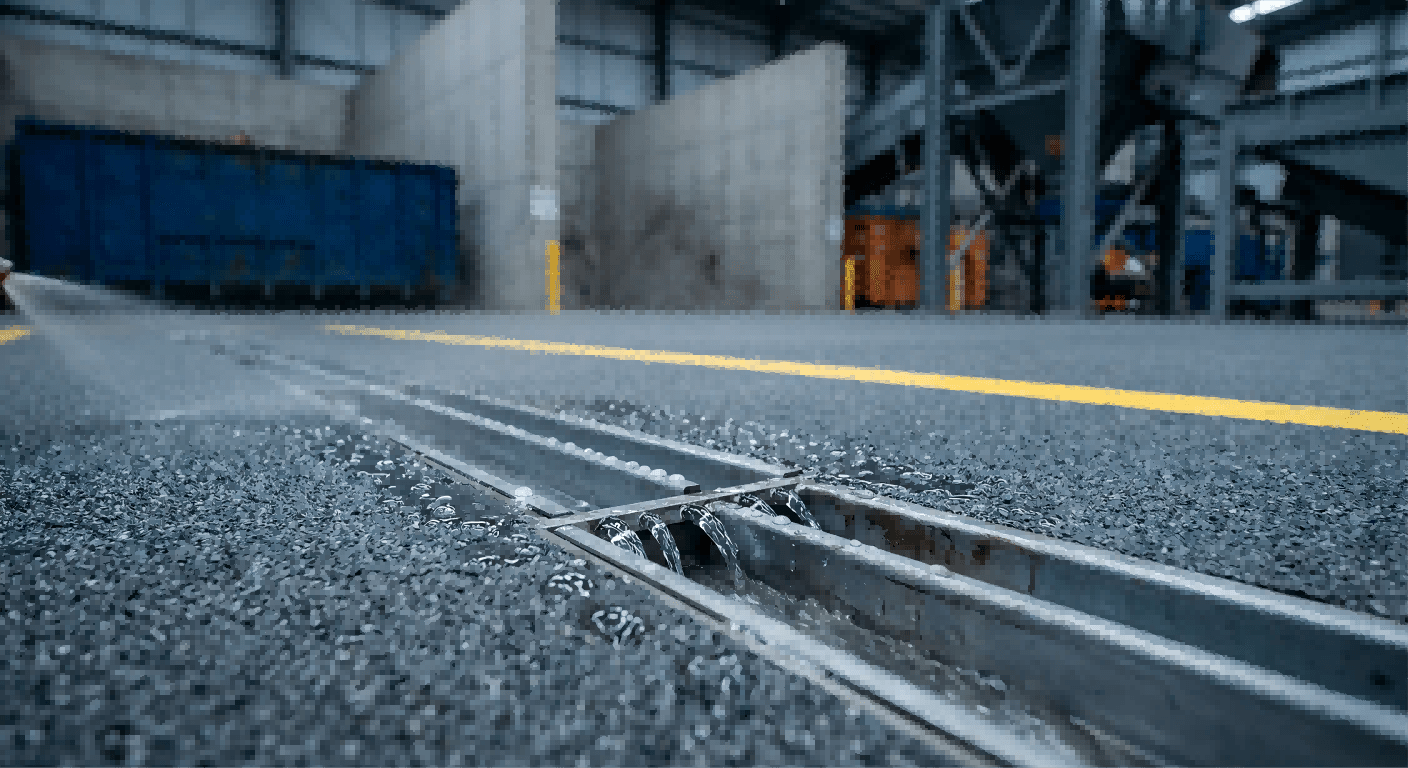
Wet floors in MSW transfer stations are not an inevitable facility norm. They are a predictable engineering failure. Specifically, the root cause is uncontrolled droplet size and gravitational settling. Therefore, standard systems cause puddling. Implementing precise dry mist odor control corrects this aerodynamic flaw. Control the droplet size to <1μm. Consequently, you fix the floor.
1. The Physics of Puddling
Governing Principle: Stokes’ Law
Every atomized droplet obeys Stokes’ Law. Terminal settling velocity (Vt) scales with the square of the droplet radius. Larger droplet = faster fall. No exceptions.
Why Standard Mist Fails
Standard Water Mist (>50 μm)
- Mass is high. Gravity dominates.
- Settling velocity is fast. Droplets hit the floor before contacting odor molecules.
- Result: rapid pooling. Leachate mixing. High-risk, low-friction surface.
Standard Dry Mist (5–10 μm)
- Settling velocity drops. But not enough.
- In enclosed, high-humidity stations, droplets still settle within 5–15 minutes.
- Result: surface condensation. Gradual puddling under continuous operation.
2. The Sub-Micron Solution: Override Gravity
Target Range: <1 μm
To stop puddling, we must shift the governing force. From gravity to Brownian Motion — random thermal collisions from surrounding air molecules.
At <1 μm, droplet mass approaches negligible. Random molecular collision forces completely counteract the gravitational vector.
Engineering Outcomes
- Terminal settling velocity → near zero
- Air suspension time → minutes to hours (exponential increase)
- Neutralizer fluid → 100% suspended in gas phase
- Floor residue → zero
The settling pathway is physically blocked. Not managed. Blocked.
3. Surface Area-to-Volume Ratio (SA/V)
The Kinetics Advantage
Dry floors are a byproduct. The primary value of <1 μm atomization is reaction kinetics.
SA/V is inversely proportional to radius: SA/V = 3/r
Compared to a standard 50 μm droplet, a 1 μm Airsafer droplet delivers 50× the reactive surface area — from the same fluid volume.
Why This Matters in MSW Environments
MSW stations carry heavy loads of:
- Hydrogen Sulfide (H₂S)
- Mercaptans
- VOCs
At <1 μm, molecular collision probability in 3D space reaches its theoretical peak. Maximum contact. Maximum reaction rate.
4. Active Gas-Phase Decomposition
Not Masking. Neutralizing.
High collision rate drives active chemical bonding. The plant-derived active compounds physically bond with organic odor molecules. They break structural bonds. They convert odor compounds into odorless, non-volatile byproducts.
Clean Formula. Clean System.
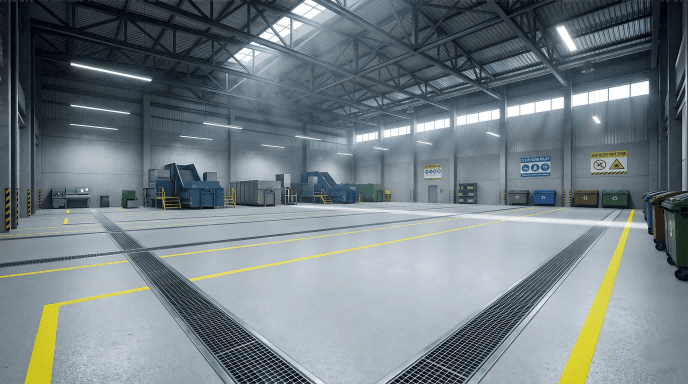
The Airsafer formula is concentrated and additive-free. Post-reaction byproducts and unreacted micro-molecules vent out through existing HVAC and exhaust ducts.
No residue on floors. No scaling in nozzles. No clogging in machinery.
Conclusion
Puddling in MSW transfer stations is a droplet size problem. Deploy the wrong size — floors get wet, surfaces get dangerous.
Deploy <1 μm sub-micron atomization. Gravitational settling stops. Floors stay dry. Brownian motion keeps the neutralizer suspended in the gas phase. Maximum surface area drives maximum odor decomposition.
This is not a chemical workaround. It is a deterministic, calculated fluid mechanics solution. Engineer the droplet size correctly. The floor problem solves itself.
Get a Custom Odor Control Solution Today