
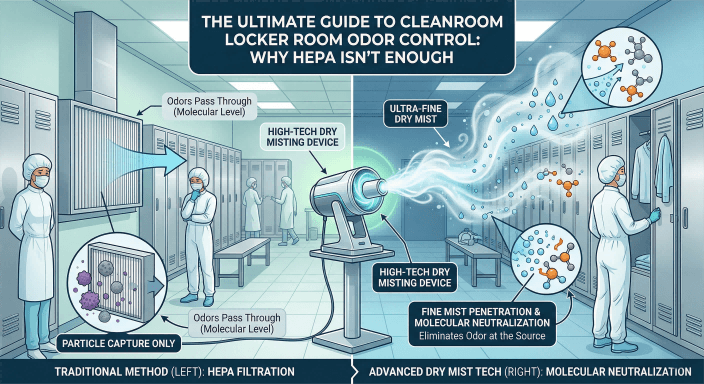
If you’ve ever spent a shift suited up in a full Tyvek cleanroom gown, you already know the problem. A Reddit thread from a semiconductor fab worker put it plainly: “We can’t wear deodorant, we’re sweating through multiple gowning layers, and the locker room smells absolutely awful by end of shift.” It’s a complaint you hear across pharmaceutical plants, medical device facilities, and microelectronics cleanrooms worldwide. And yet, despite multi-million-dollar HVAC systems and top-tier HEPA filtration, the smell never truly goes away.
The reason is straightforward: traditional filtration systems are designed to capture particles, not odor molecules. Until facilities address that gap, no amount of air changes per hour will fix the problem.
Understanding the Source: What Causes Odors in Gowning Rooms?
Before getting into solutions, it helps to understand what’s actually happening inside a typical gowning room.
Human Outgassing and VOCs
When workers suit up in enclosed, non-breathable garments like Tyvek coveralls, the body’s natural processes don’t stop. Sweat and sebum — the oily secretion from skin glands — build up fast in the warm, sealed space between skin and suit. Bacteria on the skin then break down these organic compounds through fermentation, releasing a mix of volatile organic compounds (VOCs) including isovaleric acid, butyric acid, and ammonia derivatives. In a poorly ventilated gowning room, these molecules accumulate quickly — especially in lockers and on stored garment bags where residual contamination lingers between shifts.
Microorganisms, Bacteria, and Mold
On top of the VOC problem, there’s microbial growth to contend with. Gowning rooms see high foot traffic combined with elevated humidity from perspiring workers. Dead corners behind lockers, the underside of shoe racks, and the lower sections of airlock walls tend to hold moisture — exactly the conditions that favor bacterial colonies and mold. These microorganisms are themselves a direct source of bad-smelling compounds, and because they’re embedded in surfaces rather than floating in the air, they keep re-contaminating the space even after ventilation cycles.
The “Noseblind” Effect in Clean Environments
There’s an additional irony in cleanrooms: the extreme cleanliness of the surrounding environment actually makes odors more noticeable. In a standard office or warehouse, background smells from dust, materials, and outdoor air create a sensory baseline that effectively masks mild odors. In a Class 10,000 or ISO 7 cleanroom environment, that masking baseline is gone entirely. As a result, even a relatively low concentration of odor-causing VOCs registers far more intensely to workers and visitors, amplifying complaints and affecting morale out of proportion to the actual contamination level.
The Limitation of Traditional HVAC and HEPA Filters
Given these odor sources, why don’t conventional cleanroom ventilation systems solve the problem? The answer is a fundamental mismatch between what these systems were designed for and what odor control actually requires.
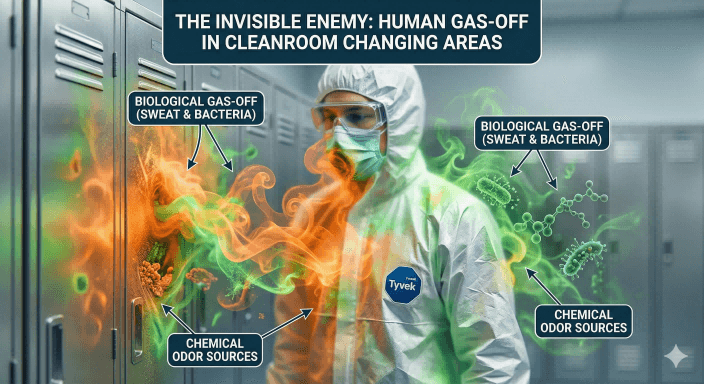
Why HEPA Traps Particles, Not Odors
HEPA filtration works by forcing air through a dense fiber matrix to capture particles 0.3 microns or larger. This is extraordinarily effective for dust, skin flakes, bacteria, and aerosol droplets — the primary contaminants of concern in cleanroom contexts. VOC molecules, though, are orders of magnitude smaller than 0.3 microns. They pass straight through HEPA filters without resistance, just as water passes through a sieve designed to catch boulders. No matter how sophisticated or well-maintained the HEPA system, odor-causing gases are simply outside its operational scope.
The Problem with Increased Air Changes (ACH)
A common facility manager response is to increase air changes per hour (ACH) — essentially diluting the odor by cycling clean air through the space more frequently. While this can reduce airborne VOC concentrations temporarily, it’s both expensive and incomplete as a long-term fix. Higher ACH rates require more powerful fans, larger ducts, and significantly higher energy consumption. More to the point, this approach does nothing to address the odor at its source. VOCs and bacteria are embedded in locker interiors, fabric surfaces, and wall joints. Pumping more clean air into the room just redistributes the contamination rather than eliminating it.
The Airsafer Solution: Dry Fog Deodorization System
This is where a fundamentally different approach becomes necessary — and where Airsafer’s Dry Fog Deodorization System comes in.
What is Micro-Atomized Dry Fog Technology?
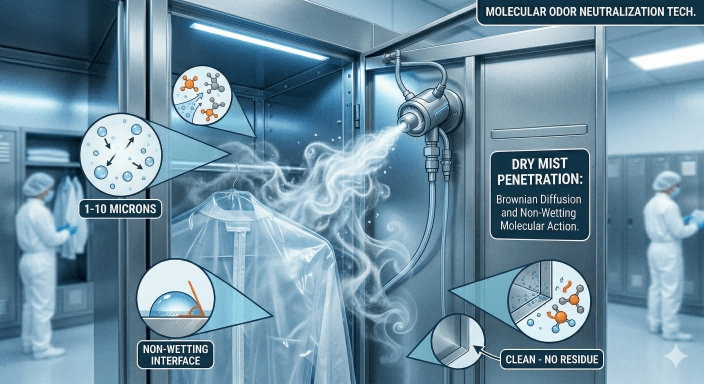
Dry fog technology works by atomizing a treatment solution into ultra-fine particles, typically 1–10 microns in diameter. At this scale, the droplets are so small that they exhibit Brownian motion — the same random thermal movement that governs gas molecules — rather than settling under gravity. In practical terms, the fog suspends in the air and spreads throughout a space in three dimensions, reaching surfaces and cavities that conventional sprays or diffusers can’t penetrate. At this droplet size, the fog doesn’t produce condensation on surfaces. There’s no wetness, no residue, and no risk to sensitive cleanroom garments, electronic components, or precision equipment.
How the Dry Mist Odor Neutralizer Works
The key distinction of Airsafer’s system is that it neutralizes rather than masks. Many commercial air fresheners work by introducing a stronger scent that overrides the perception of bad odors — a superficial fix that does nothing about the underlying chemistry. Airsafer’s odor neutralizer works through active chemical reactions: the formulation breaks down odor-causing VOC molecules at the molecular level, rendering them odorless. The active compounds also disrupt bacterial cell walls, eliminating the microorganisms responsible for continuous odor regeneration. The result isn’t a temporary improvement, but a genuine reset of the olfactory environment.
Reaching the Unreachable: 360-Degree Coverage
One of the most practical advantages of dry fog over conventional treatments is its ability to reach spaces that are essentially inaccessible by other means. Locker interiors, the gap between shoe racks and the floor, the corners of airlocks, and the dead zones behind equipment are all areas where odor-causing bacteria concentrate — and where sprays, wipes, and ventilation air rarely penetrate effectively. Because dry fog particles behave like gas molecules, they diffuse into these spaces naturally, providing 360-degree coverage without manual scrubbing or disassembly.
Key Benefits for Cleanroom Compliance and Operator Comfort
Beyond the immediate odor benefit, facilities that use Airsafer’s Dry Fog system gain a number of broader operational advantages.
Maintaining ISO 14644 and GMP Standards
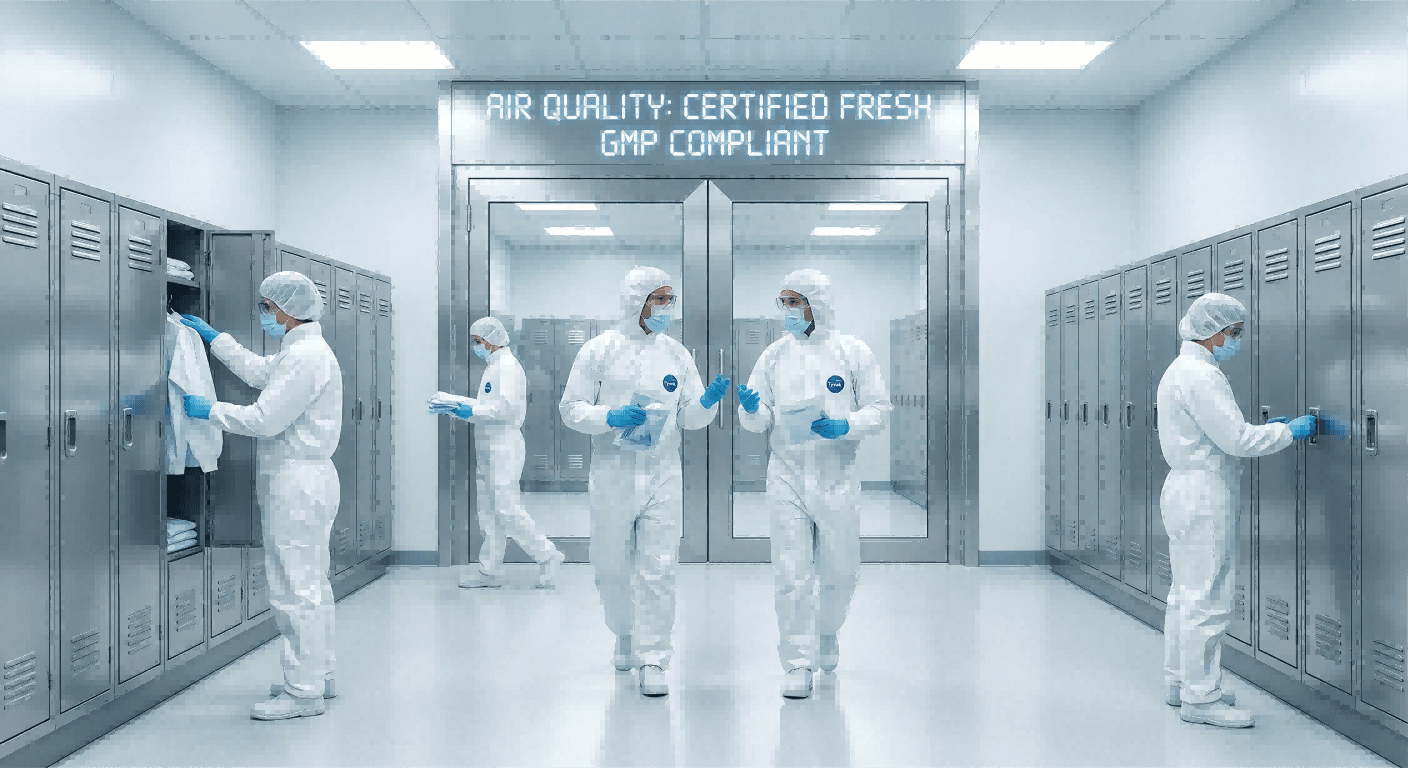
A primary concern for any cleanroom facility manager evaluating a new treatment system is whether it will introduce additional contamination. Airsafer’s dry fog formulation is engineered to leave zero residue, introduce no additional particulate matter, and contain no fragrances or volatile compounds that could compromise product integrity. The system is fully compatible with ISO 14644 cleanroom classification requirements and GMP (Good Manufacturing Practice) standards applicable to pharmaceutical and medical device environments. Facilities can treat gowning rooms and airlocks without suspending operations or triggering re-qualification events.
Improving Worker Morale and Productivity
The human dimension of this issue shouldn’t be underestimated. Workers who spend eight or more hours per shift in enclosed cleanroom environments are acutely aware of gowning room conditions. A persistently bad-smelling locker room isn’t merely an inconvenience — it signals to employees that their comfort and working environment aren’t being prioritized. Facilities that address this problem proactively report improved morale, fewer complaints, and in some cases lower turnover among cleanroom operators. Clean air is, quite literally, a quality-of-life issue for the people who rely on it every day.
Frequently Asked Questions
Q : How do you control odor in a cleanroom gowning room?
A: Effective odor control in a gowning room requires addressing both airborne VOCs and surface-embedded bacteria at the same time. While HVAC and HEPA systems handle particulate contamination, a dedicated solution like Airsafer’s Dry Fog Deodorization System is needed to neutralize odor-causing molecules and eliminate the microbial sources that continually regenerate them.
Q: Will dry fog make cleanroom garments wet or moldy?
A:No. The “dry” in dry fog isn’t a marketing term — it refers to a specific particle size range (under 10 microns) at which droplets don’t coalesce into liquid on contact with surfaces. Garments, gloves, and equipment treated with Airsafer’s dry fog system stay completely dry immediately after treatment, with no risk of moisture-induced mold growth.
Q:Are the odor neutralizers safe for cleanroom environments?
A: Yes. Airsafer’s formulation contains no fragrances, no silicones, and no compounds that would leave detectable residue on surfaces or in the air. The active ingredients break down after neutralizing their target molecules, leaving the environment chemically clean and compliant with ISO and GMP requirements.
Conclusion
The persistent odor problem in cleanroom gowning rooms isn’t a reflection of poor housekeeping — it’s a structural limitation of filtration-only approaches to air quality. HEPA filters are among the most effective particle-capture technologies available, but they were never designed to address VOCs, and increasing air changes merely redistributes rather than eliminates odor at its source.
Airsafer’s Dry Fog Deodorization System addresses the problem at every level: neutralizing VOC molecules chemically, eliminating odor-generating bacteria at the cellular level, and reaching the inaccessible spaces where contamination builds up — all without introducing residue or compromising cleanroom compliance.
Ready to transform your gowning room environment? Contact the Airsafer team today for a customized assessment of your facility’s deodorization needs. Our specialists will evaluate your specific cleanroom classification, gowning room layout, and operational requirements to design a solution that works for your team.