

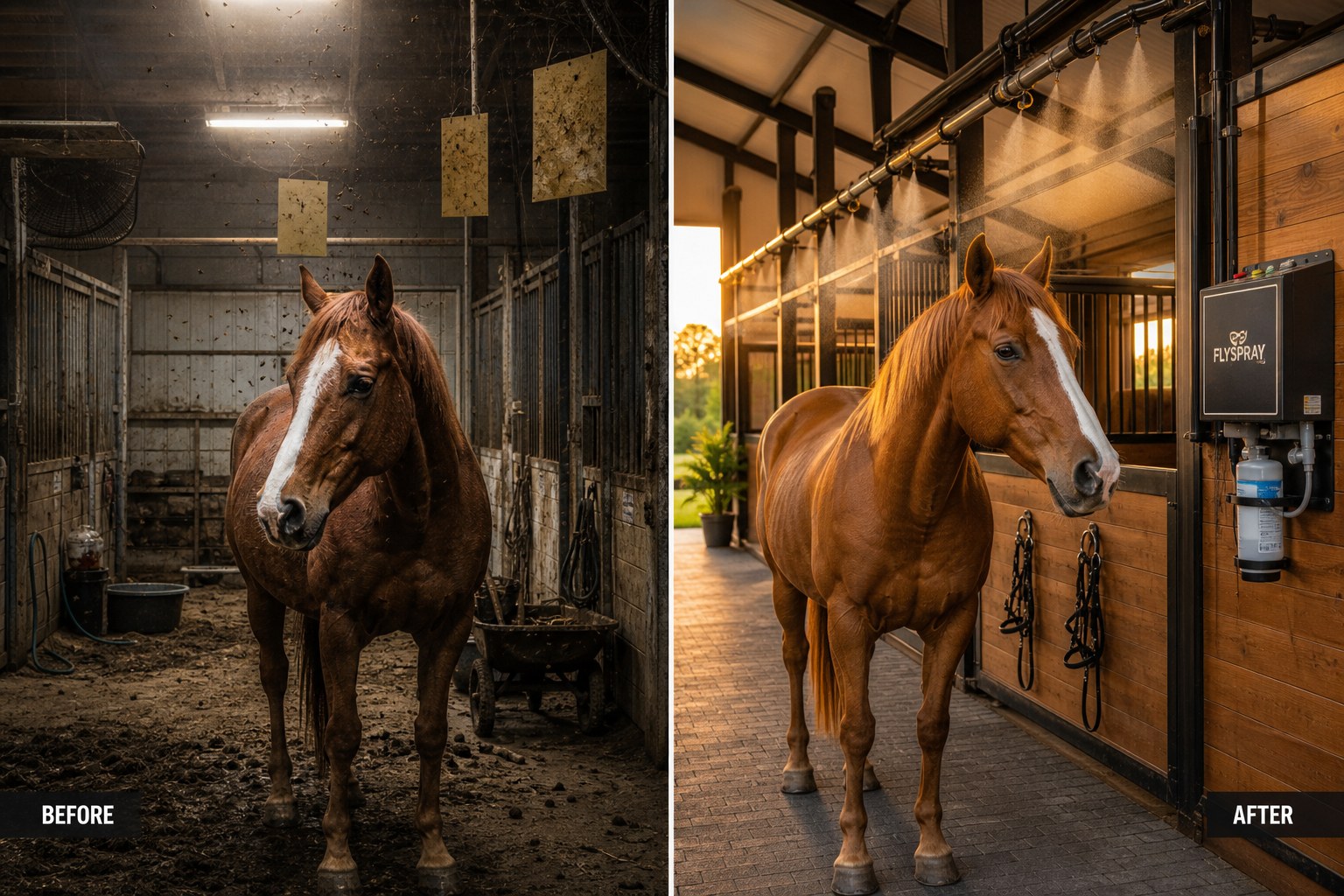
If you manage a horse barn, you already know the drill — spraying fly repellent by hand three times a day, hanging sticky traps that fill up by noon, and still watching your horses stomp and swish through every hot afternoon. I’ve been there. So has every barn owner I know.
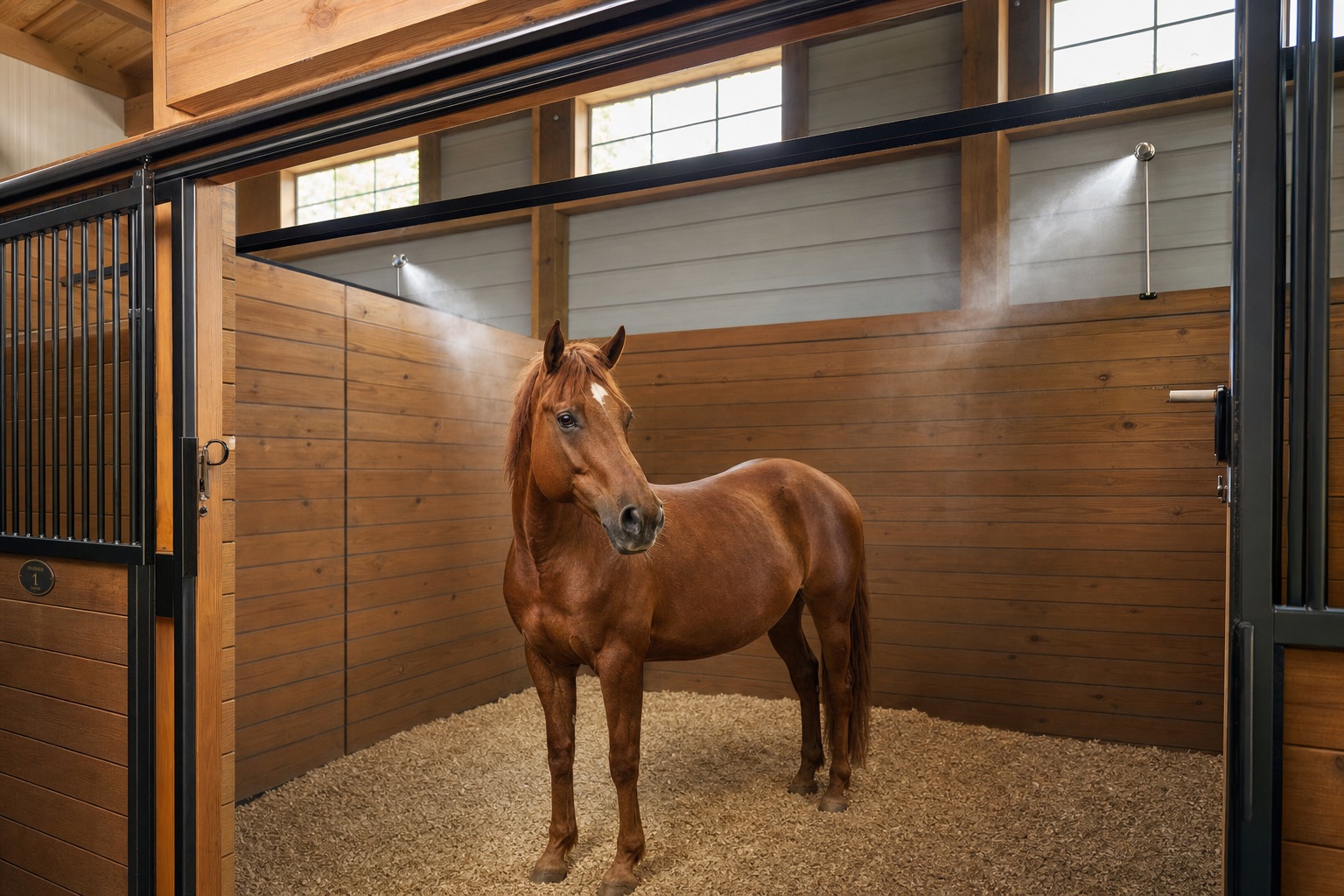
A barn fly spray system flips the whole thing on its head. Instead of playing catch-up with chemicals and manual labor, an automatic system sprays on a schedule — 4 to 6 times daily, at higher concentrations than a mosquito setup, covering every stall, aisle, and loafing area without you lifting a finger. You do nothing. It just runs.
Why Flies Are a Bigger Problem Than Mosquitoes in Barns
The Barn Fly Challenge: Volume, Speed, and Resistance
Mosquitoes are seasonal, slow, and solitary. Barn flies are none of those things. A single female house fly can lay 500 eggs in her lifetime, and under barn conditions — manure, damp bedding, feed residue — the full egg-to-adult cycle completes in as little as 7 days. I’ve watched it happen in a barn that skipped treatment for ten days in June. A modest fly population exploded to thousands within two weeks.
The species hitting barns also differ in behavior. Stable flies bite through skin and clothing, targeting legs and flanks, which drives horses to constant stomping and reduced feed intake. Horse flies deliver deep, painful bites that can draw blood. Face flies cluster around eyes and nostrils, spreading conjunctivitis and other infections. None of these respond well to the passive mosquito traps or low-concentration fogging that works on patios. Barn flies move fast, breed relentlessly, and require active suppression — not just occasional knockdown.
User Pain Points: When “Fly-Free” Becomes a Daily Battle
Most barn owners don’t realize how much time they’re losing to fly control until they add it up. Let me do it for you. Manual spraying: 20 minutes per session, 3 times daily, every day from May through October — that’s over 180 hours per season just walking stalls with a pump sprayer. Then there’s the cost of aerosol sprays, pour-ons, feed-through larvicides, and sticky traps, each attacking one stage of the fly life cycle but none delivering full coverage.
The real cost shows up in the horses. Flies cause stress behaviors that impact health and performance: weight loss from constant movement, hoof problems from excessive stomping, and respiratory irritation from flies clustering in nostrils. Vets I’ve talked to consistently link heavy fly pressure to summer weight loss and behavioral issues in stalled horses. For breeding operations, face-fly-transmitted eye infections can derail an entire foaling season. The question isn’t whether flies cost you money — it’s how much you’re spending on half-measures that still leave your horses miserable.
Mosquito Misting vs. Barn Fly Spray Systems: Key Technical Differences
It’s tempting to look at a mosquito misting system and assume it’ll handle barn flies too. The hardware looks similar — a tank, a pump, nozzles on a timer. But what comes out of those nozzles and how often — that’s where everything changes.
Spray Frequency: 2-3 Times vs. 4-6 Times Daily
A mosquito system typically runs twice a day — dawn and dusk, when mosquitoes are active and the air is still. That’s fine for an insect that rests during midday heat. Barn flies are most aggressive from late morning through late afternoon, exactly when the temperature peaks and horses are most active. A two-spray schedule misses the entire window of peak fly pressure.
An automatic fly spray system for barns runs 4 to 6 times daily, with the heaviest coverage concentrated between 10 AM and 4 PM. Some operators add a seventh “knockdown” spray at noon when temperatures cross 90°F and fly activity spikes.
Chemical Concentration: Why Barn Flies Need Stronger Formulas
This is where the systems diverge completely. Mosquito misting formulas are diluted for residential use — low enough to be safe around people, pets, and food surfaces. Barn flies, especially the biting species, have thicker exoskeletons and higher metabolic resistance. A horse fly can absorb several times the dose that kills a mosquito and keep biting.
Barn fly concentrates are mixed at notably higher ratios, typically using pyrethrum combined with synergists like piperonyl butoxide (PBO) that block the fly’s ability to detoxify the active ingredient. Running a mosquito-concentration formula through a barn system is the single most common reason these installations fail — the flies survive the mist, develop resistance, and the system gets blamed for what’s really a formulation problem. I’ve seen barns tear out perfectly good hardware over this. No shortcuts.
Timing Strategy: The Critical Afternoon Spray Window
Mosquito systems run on a predictable dawn/dusk rhythm tied to photoperiod. Barn fly systems need what operators call “thermal-triggered intervals” — shorter gaps between sprays as the temperature climbs.
A typical summer schedule: 6 AM (light mist to knock down overnight accumulation), 10 AM, 12 PM, 2 PM, 4 PM, and an optional 7 PM treatment. The 12 PM and 2 PM sprays are non-negotiable in most regions — I’ve timed it. Skip them once on a 95°F day, and you’ll see flies back on horses within 45 minutes.
This is why programmable digital timers with multiple daily events are standard on barn systems, where a simple dawn/dusk analog timer suffices for mosquito setups.
How Automatic Barn Fly Spray Systems Work
High-Pressure Misting Nozzles for Livestock Environments
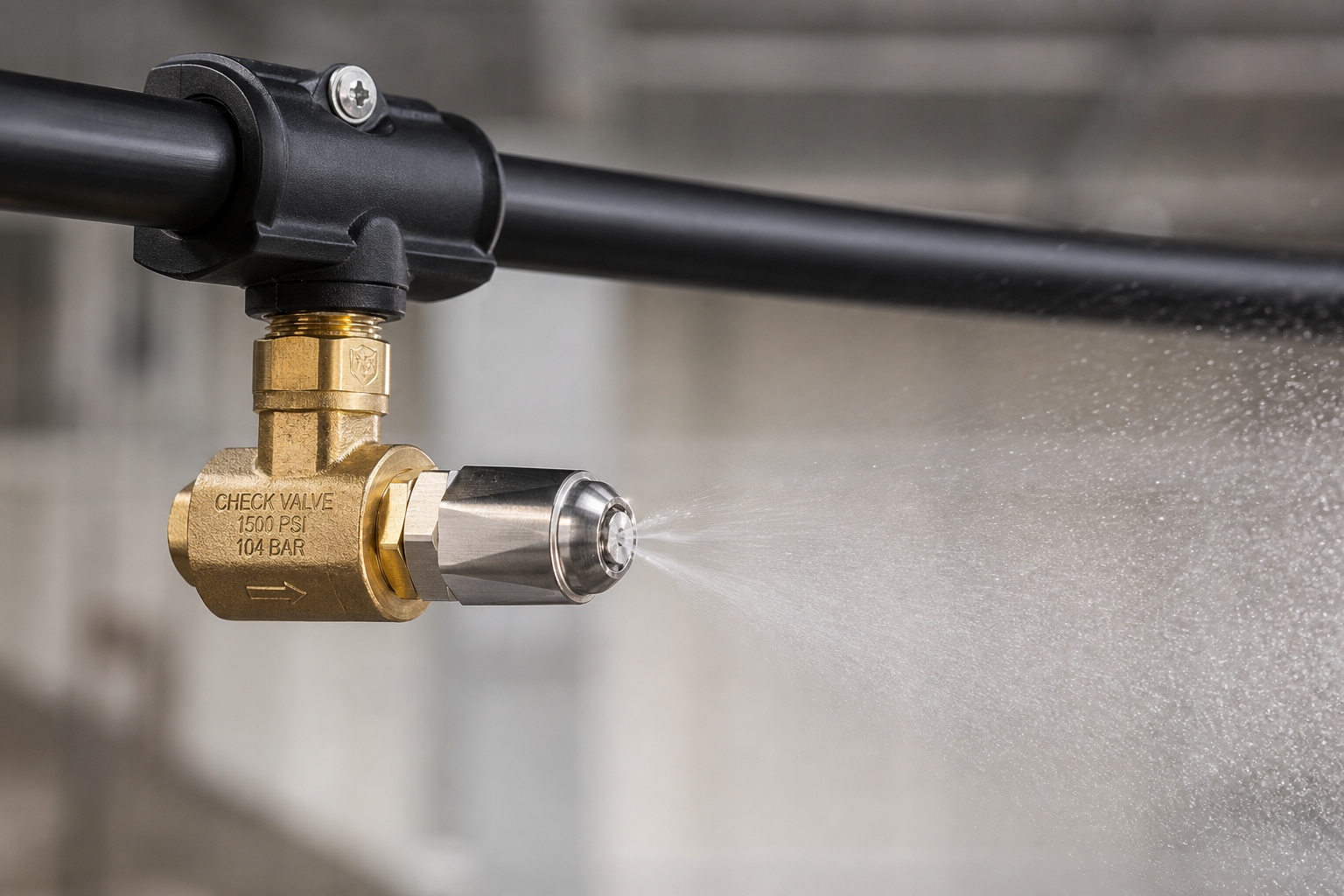
The core of any barn fly spray system is the nozzle array. These aren’t the foggers used in greenhouse misting or the low-pressure drip emitters on garden irrigation. Barn fly nozzles run at 100–250 PSI through stainless steel or brass orifice tips, producing a fine atomizing spray with droplets in the 30–60 micron range.
At that size, droplets stay airborne long enough to contact flying insects but are heavy enough to settle on surfaces where flies rest — stall dividers, feed trough lips, aisle railings. The high pressure misting nozzles are typically brass or 304 stainless, rated for continuous chemical exposure, and fitted with check valves that prevent drip-back and chemical waste between spray cycles.
Timer Systems: Analog vs. Digital Programmable Options
The timer is the brain of the system, and choosing the right one determines whether your setup actually hits the critical spray windows.
Analog timers offer simplicity — set pins for on/off times and walk away — but usually cap at 2–3 daily events. Not enough for a barn application. Digital programmable controllers handle 6–12 daily events, allow different weekday/weekend schedules, and some include rain sensors or temperature thresholds that skip or add sprays based on conditions.
An automatic spray dispenser with digital programming is what separates a system that runs on autopilot from one you’re constantly adjusting by hand. For larger operations, some controllers support multiple zones — running the stall row on a different schedule than the indoor arena or wash rack.
Coverage Calculations: Stalls, Aisles, and Outdoor Areas
Nozzle placement follows a simple rule: one nozzle covers roughly 8–10 linear feet of stall or aisle space when mounted at 8–10 feet height. A standard 12×12 stall needs one nozzle centered on the back wall, angled slightly downward. Aisles under 12 feet wide get nozzles every 10 feet along one side. Wider aisles or open areas need staggered placement on both sides.
For a typical 8-stall barn with a center aisle: 8 stall nozzles + 4-5 aisle nozzles = 12-13 total. Add 2-3 more for wash racks, tack rooms, or covered outdoor areas where horses stand. Over-nozzling wastes concentrate; under-nozzling leaves dead zones where flies congregate. Get the spacing right the first time.
Types of Automatic Fly Spray Systems for Barns
Pre-Configured Kits: 4-Stall, 8-Stall, and Large Barn Solutions
Most manufacturers offer tiered kits sized by stall count. A 4-stall kit typically includes a 30-gallon reservoir, a diaphragm pump, 8-10 nozzles, 200 feet of tubing, and a basic digital timer. An 8-stall kit doubles the nozzle count and bumps the reservoir to 55 gallons. These kits work well for straightforward layouts — two rows of stalls facing a center aisle, standard ceiling height, no unusual obstacles.
Where kits fall short: L-shaped barns, barns with attached indoor arenas, or facilities with multiple disconnected buildings. If your layout doesn’t match the kit diagram, you’ll end up with coverage gaps or wasted nozzles pointed at walls.
Custom-Built Systems for Large Operations
Barns with 12+ stalls, indoor arenas, or multiple buildings need zone-based designs. These run separate nozzle circuits on independent timers — the stall row gets 6 daily sprays while the arena gets 2-3 during training hours only. Custom systems cost more upfront but eliminate the waste of spraying empty spaces on a blanket schedule.
For breeding farms or large boarding operations, zone control also lets you adjust concentration by area. Foaling stalls might run a lighter formula safe for newborns, while the main barn runs full-strength. That flexibility doesn’t exist in a one-size kit.
Choosing the Right Fly Spray Concentrate
Pyrethrum-Based Formulas: The Gold Standard
Natural pyrethrum — extracted from chrysanthemum flowers — remains the most effective active ingredient for barn fly systems. It delivers rapid knockdown (flies drop within seconds of contact) and breaks down quickly in sunlight, which means low residual toxicity for horses and handlers. The synthetic versions (permethrin, cypermethrin) last longer but build resistance faster.
What matters is the synergist. Piperonyl butoxide (PBO) at a 5:1 or 10:1 ratio to pyrethrum blocks the enzyme (cytochrome P450) that flies use to metabolize the insecticide. Without PBO, you’re giving flies a training dose that makes the next generation harder to kill.
Natural and Botanical Alternatives
Some operations — especially organic farms or facilities near waterways — can’t use synthetic pyrethroids. Botanical options include citronella oil, lemongrass extract, and neem-based concentrates. They work, but with caveats: shorter residual activity (30-60 minutes vs. 2-3 hours), higher application rates, and more frequent refills.
If you go botanical, plan on running 6+ spray cycles daily instead of 4, and accept that you’re managing fly pressure rather than eliminating it. For operations where chemical sensitivity is a real concern — horses with skin allergies, barns adjacent to organic crop fields — the tradeoff is worth it.
Concentration Ratios for Different Fly Species
Not all flies need the same dose. House flies and face flies go down at standard dilution (typically 1 oz concentrate per gallon of water). Stable flies need 1.5x that ratio. Horse flies and deer flies — the big biters — may need 2x concentration or a formula specifically labeled for biting flies.
Mix too light and you’re wasting money on mist that annoys flies without killing them. Mix too heavy and you burn through concentrate twice as fast with diminishing returns. Start at the label rate, monitor fly counts for a week, then adjust up if you’re still seeing landing activity during peak hours.
Installation Guide for Barn Fly Spray Systems
Step-by-Step: Installing Nozzles in Stalls and Aisles
Mount nozzles at 8-10 feet — high enough that horses can’t reach them, low enough for effective coverage. Use stainless steel mounting brackets rated for outdoor/agricultural use. Plastic brackets crack in cold weather and vibrate loose from pump cycling.
Run the main supply line along the roofline or top plate, then drop short feeder lines to each nozzle. Use UV-resistant nylon tubing (not PVC — it gets brittle) with compression fittings at every junction. Test the entire system with plain water before adding concentrate. Run it for a full day on water only. You’ll find every leak, every weak fitting, every nozzle that sprays the wall instead of the stall. Fix those problems with 2 fittings now instead of discovering them after you’ve loaded 40 worth of concentrate into the lines.
Programming Your System: Spray Intervals and Duration
Start with this baseline schedule and adjust from there:
- 6:00 AM — 30-second burst (morning knockdown)
- 10:00 AM — 45-second spray (pre-heat buildup)
- 12:00 PM — 45-second spray (peak activity begins)
- 2:00 PM — 45-second spray (peak activity)
- 4:00 PM — 45-second spray (late afternoon push)
- 7:00 PM — 30-second burst (evening settle, optional)
Each spray event should run 30-45 seconds — long enough for full nozzle pressurization and even coverage, short enough to avoid pooling on surfaces. If you see wet spots on stall floors after a cycle, reduce duration by 10 seconds. If flies return within an hour of spraying, increase duration or add a mid-cycle event.
Maintenance and Troubleshooting
Refill Schedules: How Much Concentrate You’ll Use
A typical 8-stall system running 5 daily cycles at 45 seconds each burns through roughly 1.5-2 gallons of diluted solution per day. With a 55-gallon reservoir, that’s about 4 weeks between refills in peak season. Concentrate usage depends on your dilution ratio — at 1 oz per gallon, a single gallon of concentrate makes 128 gallons of spray solution. One gallon of concentrate lasts most 8-stall barns 6-8 weeks.
Mark your calendar. Running the system dry doesn’t just stop fly control — it can damage the pump by running it without fluid. Most digital controllers have a low-level sensor option. Use it.
Winterization: Protecting Your System in Cold Months
When nighttime temperatures consistently drop below 35°F, it’s time to winterize. Drain all lines completely — trapped water freezes, expands, and cracks fittings or nozzle bodies. Disconnect the pump and store it indoors. Blow compressed air through the tubing to clear residual liquid from low spots.
Cap all nozzle openings to keep wasps and dirt daubers from nesting inside over winter. Come spring, you’ll thank yourself when the system fires up clean instead of spitting mud and dead insects for the first three cycles.
Common Issues: Clogs, Leaks, and Pressure Problems
Clogged nozzles: The #1 maintenance issue. Concentrate residue builds up in the orifice over time, especially with botanical formulas. Soak nozzle tips in warm vinegar solution monthly during heavy-use season. Keep spare tips on hand — they’re $3-5 each and not worth the downtime of cleaning a badly fouled one.
Pressure drops: Usually a leak somewhere in the line, a failing pump diaphragm, or a clogged inline filter. Check the filter first — it’s the easiest fix. If pressure is fine at the pump but weak at distant nozzles, you’ve got a line restriction or too many nozzles on one circuit.
Leaking fittings: Compression fittings loosen over time from vibration and thermal cycling. Hand-tighten quarterly. If a fitting keeps leaking after re-tightening, replace the ferrule — they’re single-use components that deform on first installation.
FAQ: Barn Fly Spray Systems Answered
Do automatic fly spray systems really work?
Yes — when set up correctly. The systems that “don’t work” almost always have one of three problems: wrong concentration (too dilute), wrong schedule (not enough daily sprays), or wrong nozzle placement (dead zones in the coverage pattern). Fix those three variables and the hardware does exactly what it’s supposed to. I’ve seen barns go from unbearable to virtually fly-free in 48 hours after correcting a dilution ratio.
How often should a barn fly system spray?
Four to six times daily minimum during fly season. Mosquito systems get away with twice a day because mosquitoes are only active at dawn and dusk. Barn flies work all day, peaking in the early afternoon heat. If you’re only spraying morning and evening, you’re missing the 6-hour window when 70% of fly activity happens.
Can I use mosquito misting concentrate for barn flies?
You can, but it probably won’t work well enough. Mosquito concentrates are formulated at lower concentrations for smaller, less resistant insects. Barn flies — especially horse flies and stable flies — have thicker exoskeletons and higher metabolic resistance. You need a concentrate specifically labeled for biting flies, mixed at the higher ratio listed on the label. I’ve seen too many barn owners try to save money by running mosquito juice through their barn system. They end up spending more in the long run when flies develop resistance and the whole formula needs to be swapped out.
How much does a barn fly spray system cost to run per season?
Most systems burn through 2-3 gallons of concentrate per month in peak season. At 40-60 per gallon, you’re looking at 240-540 for a full May-through-October run. Compare that to 180 hours of manual spraying — even valuing your time at minimum wage, the system pays for itself in labor alone by mid-July.
Are automatic fly spray systems safe for horses?
Yes — when installed correctly. Nozzles mount above head height (8-10 feet), and the mist settles as a fine film, not a direct spray to the face. The concentrates used are the same pyrethrins found in equine fly sprays, just delivered more efficiently. Keep feed and water covered during spray cycles as a precaution. In three years of running these systems, I haven’t seen a single adverse reaction in a horse — and I’ve talked to dozens of barn managers who say the same.
What’s the difference between a barn fly system and a pest fogger?
A pest fogger machine dumps a heavy cloud of insecticide all at once — you evacuate the barn, fog it, wait 2 hours, then bring horses back in. It kills what’s there but offers zero residual protection. An automatic system delivers lighter doses throughout the day, maintaining a constant barrier instead of a one-time nuke. For daily fly pressure, the automatic system wins every time. Foggers have their place for severe infestations as a reset, but they’re not a daily management tool.
Ready to Stop Fighting Flies by Hand?
If you’re tired of the spray-stomp-repeat cycle, an automatic barn fly system is the fix. We design misting systems for livestock environments — higher concentration, more spray cycles, and digital programming that handles the schedule so you don’t have to. Talk to our team about sizing a system for your barn.