
Table of Contents
- Why basements smell: the root causes of below-grade odors
- Why traditional basement odor solutions fail
- How dry fog technology eliminates basement odors at the source
- 7 proven methods to eliminate basement odors with dry fog
- Step-by-step: installing a dry fog system in your basement
- Basement odor prevention: maintenance tips for long-term results
- Case study: eliminating musty odors in a commercial basement
- FAQ: common questions about basement odor control
- Conclusion
Why Basements Smell: The Root Causes of Below-Grade Odors
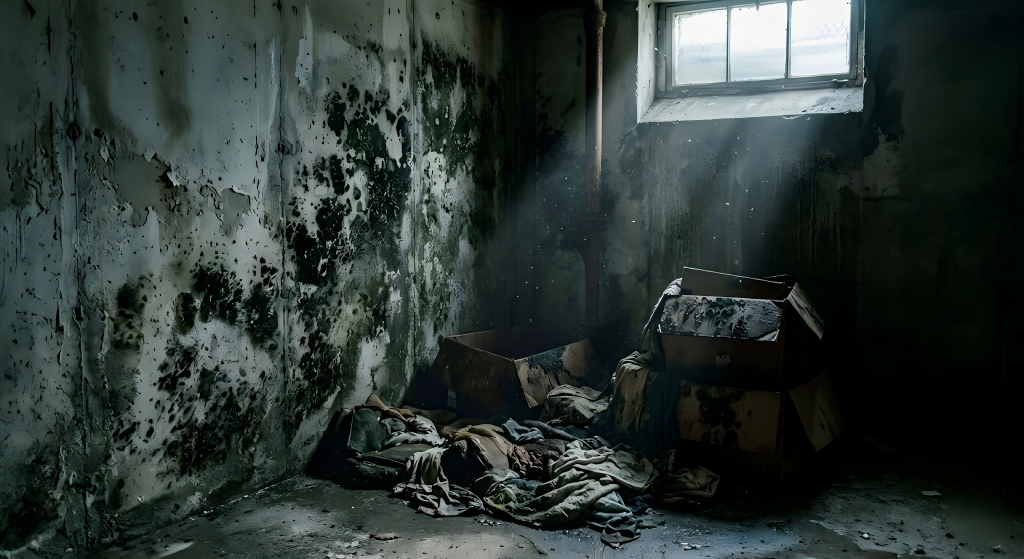
To eliminate basement odors for good, first understand why below-grade spaces develop persistent smells. Basements sit partially or fully underground, in direct contact with soil moisture. That creates conditions where four distinct odor sources converge.
Mold and Mildew Growth
Mold is the most common culprit behind musty basement smell. Below-grade walls wick moisture from surrounding soil through capillary action. When relative humidity exceeds 60%, mold spores colonize porous materials—drywall, wood framing, cardboard. The volatile organic compounds (VOCs) released during mold metabolism are what you smell. Once established, colonies keep producing odor even when surface moisture looks minimal.
Sewer Gas and Plumbing Issues
Your basement’s floor drain, laundry standpipe, or unused bathroom can be a pipeline for sewer gas. Water in P-traps evaporates when fixtures go unused for weeks, breaking the seal that blocks methane and hydrogen sulfide. In commercial settings, sewer gas smells in buildings are a well-documented problem demanding systematic control. Even a small crack in a drain trap can foul an entire below-grade level.
Poor Ventilation and Humidity Traps
Basements are the least ventilated spaces in any building. Air exchange rates can be as low as 0.1 to 0.2 air changes per hour, versus 3 to 5 for above-grade spaces. Stagnant air lets humidity accumulate and odor molecules concentrate. Even minor sources become overwhelming when nothing moves the air.
Organic Decay and Stored Materials
Basements tend to store things that slowly decompose: cardboard absorbing moisture, old fabrics, forgotten food, dead pests in wall cavities. Protein decay produces amines and sulfur compounds. Cellulose decay generates earthy-smelling geosmin. When multiple materials decompose simultaneously in a confined, humid space, the composite odor becomes particularly stubborn.
Why Traditional Basement Odor Solutions Fail
Most homeowners cycle through the usual remedies and never actually eliminate basement odors. Here’s why.
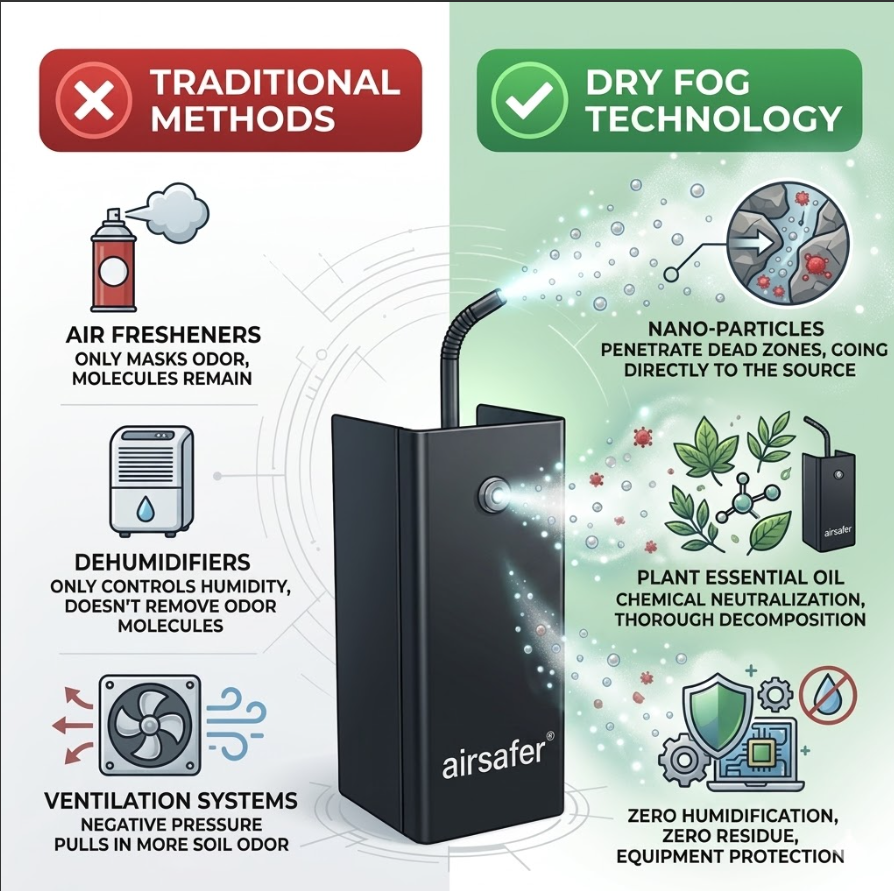
Air Fresheners Only Mask the Problem
Spray fresheners, plug-in diffusers, and scented beads superimpose a stronger scent over the existing odor. They don’t neutralize or destroy odor molecules. Within hours, the masking fragrance fades and the underlying musty smell returns, unchanged. Worse, many synthetic fragrances add VOCs of their own to the air. Masking is not remediation.
Dehumidifiers Don’t Eliminate Odor Molecules
Dehumidifiers handle moisture control, and they’re genuinely useful for that. But they address only relative humidity. Lowering humidity to 45% slows mold metabolism. It does nothing to eliminate odor molecules already in the air or adsorbed onto surfaces. A basement can have perfect humidity and still smell terrible if a floor drain trap has dried out or mold has colonized behind finished walls. Dehumidifiers pull water vapor from the air. They don’t neutralize odors.
Ventilation Systems Struggle with Below-Grade Spaces
Conventional ventilation hits fundamental problems in basements. Exhaust-only systems create negative pressure that pulls more soil gases through foundation cracks. Balanced HRV/ERV systems need significant ductwork modifications and still only dilute odors instead of eliminating them at the molecular level. For real basement odor removal, you need technology that actively neutralizes odor compounds. Not something that just moves them around.
How Dry Fog Technology Eliminates Basement Odors at the Source
Traditional approaches either mask, manage moisture, or move air. None destroy odor molecules where they originate. Dry fog technology takes a fundamentally different approach. It deploys a cloud of sub-micrometer particles that behave like a gas, reaching every crevice and neutralizing odor compounds through direct chemical interaction with botanical or microbial agents.
What is Nano-Scale Dry Fog?
Nano-scale dry fog is a precisely engineered aerosol with mean particle diameter below one micrometer—less than 1 μm. A human hair is roughly 70 to 100 μm wide; dry fog particles are about 100 times smaller. At this scale, particles exhibit gas-like diffusion: they stay suspended and follow air currents into every corner and cavity. The science of atomization behind this relies on ultra-low-pressure membrane oscillation that shears liquid deodorizing media into uniform nano-scale droplets—no heat, no high pressure.
Why Sub-1μm Particles Penetrate Basement Cavities
Standard misting systems produce 20 to 100 μm droplets. Gravity pulls them down—they fall, settle, leave visible wetness. Dry fog particles below 1 μm are lighter than air’s natural buoyancy forces at that scale. So they stay airborne and penetrate spaces no spray or wipe can reach: the cavity behind drywall where mold grows, the inside of a dried-out floor drain trap, the interstitial space between insulation and foundation wall, the porous surface of stored boxes.
Chemical-Free Botanical Neutralization
The best dry fog systems use botanical deodorizing media rather than synthetic chemicals. Plant-derived terpenes and flavonoids chemically bond with odor-causing molecules—amines, mercaptans, hydrogen sulfide—and transform them into non-volatile, odorless compounds. Oil-based formulations resist freezing and need no dilution. Unlike enzymatic cleaners that need specific temperature and pH conditions, botanical neutralization works across a wide range of basement environments, consistent with science of odor control principles of molecular-level neutralization.
No Wetting, No Residue, No Equipment Damage
Total liquid volume dispersed is tiny—milliliters per hour—so surfaces stay completely dry. Zero humidity increase, no condensation on cold walls, no residue on stored furniture or documents, no corrosion risk to electrical panels or electronics. This makes dry fog suitable even for basements housing sensitive equipment or archival storage.
7 Proven Methods to Eliminate Basement Odors with Dry Fog
Based on real-world deployments, here are seven approaches to eliminate basement odors using dry fog. Combining methods usually yields the fastest results.
Method 1: ASX-01 for Small Basements (Up to 30 m²)
For basements under 30 m²—a single finished room, utility area, or compact wine cellar—one ASX-01 unit handles the whole space. This entry-level system has one atomizer delivering <1 μm dry fog particles, noise below 30 dB. The low-power host draws minimal electricity (around 0.5 kWh/month). The 200 ml botanical cartridge lasts 30 to 60 days. Installation takes under 30 minutes: wall-mount the unit centrally and program the schedule.
Method 2: ASX-03 for Medium Underground Spaces (Up to 90 m²)
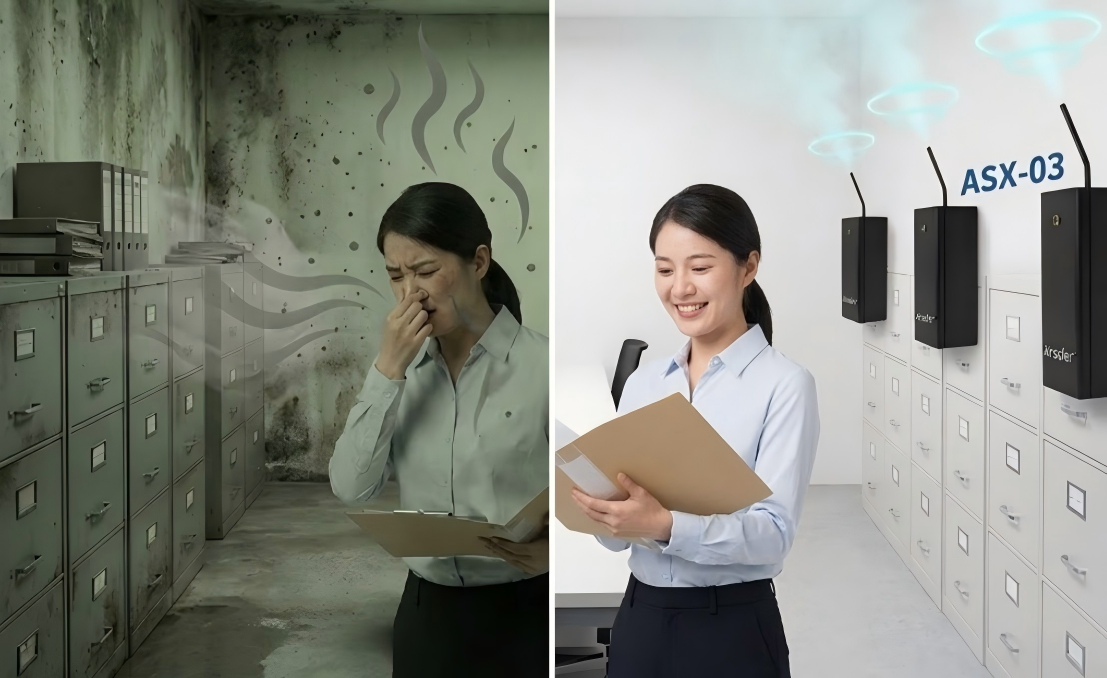
Basements between 30 and 90 m²—common in single-family homes—fit the ASX-03. Its three atomizer units share the same low-power host as the ASX-01. Position them in a triangle for even coverage across partitioned areas, storage closets, and utility rooms. The distributed architecture eliminates dead zones. Industrial odor control strategies use similar multi-point deployment at larger scales.
Method 3: Targeted Fogging for Musty Corners
When your musty basement smell concentrates in one area—a crawlspace access point, sump pump corner, laundry alcove—targeted fogging with a single atomizer at the source works remarkably well. Dry fog diffuses from the emission point and saturates the local air volume. A good supplemental strategy when the main basement is fine but one zone stays problematic.
Method 4: Scheduled Treatment for Continuous Protection
Basement odors are rarely a one-time problem. Seasonal groundwater changes and variable humidity mean odor sources wax and wane. Dry fog systems handle this with 24-hour four-group programmable scheduling and peak/off-peak automatic adjustment. A typical schedule: early-morning peak treatment, mid-day maintenance, evening refresh, overnight standby. The system modulates output to match demand, conserving media during low-odor periods.
Method 5: Botanical Media for Mold-Related Odors
When mold and mildew are the primary odor source, oil-based botanical concentrate media delivers targeted results. Plant-derived terpenes and flavonoids neutralize the VOCs produced by mold metabolism—the compounds responsible for musty smells. Because the formulation is oil-based, it stays effective year-round without freezing. Important for unheated basement installations.
Method 6: Microbial Media for Organic Decay Smells
For odors from decomposing organic matter—sewer gas backup, decaying stored materials—microbial deodorizer media offers a complementary approach. Live-culture microorganisms biodegrade the proteins, fats, and carbohydrates that generate malodorous compounds. In wastewater treatment odor eradication applications, this dual botanical-microbial approach has demonstrated significant reduction in complex organic waste environments.
Method 7: Combined Approach for Severe Basement Odor Problems
Severe problems—multiple source types, extensive mold colonization, persistent sewage gas—respond best to a combined approach. Layer an ASX-03 for full coverage, botanical cartridges for VOC neutralization, supplemental microbial media near organic decay sources, and aggressive scheduling during the first 30 days to break the odor cycle. After intensive treatment, step down to maintenance levels. This mirrors the layered approach used in industrial odor solution programs for complex, multi-source environments.
Step-by-Step: Installing a Dry Fog System in Your Basement
Proper installation makes the difference between temporary relief and permanent odor removal. Here are the four steps.
Step 1: Assess Your Basement Size and Odor Sources
Measure total floor area in square meters. Identify every potential odor source: floor drains (check P-trap water levels), foundation cracks, sump pump basins, finished walls with suspected mold, stored organic materials, visible moisture staining. Document the layout—open floor plan versus partitioned rooms—because this determines single-unit versus multi-unit deployment.
Step 2: Choose the Right ASX Model
Match your square footage to the right model:
| Basement Size | Recommended Model | Atomizer Units | Coverage |
|---|---|---|---|
| ≤30 m² | ASX-01 | 1 | 30 m² |
| 30–60 m² | ASX-01 (supplemental) or ASX-03 | 1–3 | Up to 90 m² |
| 60–90 m² | ASX-03 | 3 | 90 m² |
| 90–180 m² | ASX-06 | 6 | 180 m² |
| 180–270 m² | ASX-09 | 9 | 270 m² |
For partitioned basements, err toward more atomizer units to ensure each enclosed area gets coverage.
Step 3: Position Units for Maximum Coverage
For a single-unit ASX-01, mount at roughly 2.0 to 2.2 m height on a central wall or from the ceiling at the room’s geometric center. Avoid corners—you’re wasting coverage into the foundation wall. For the ASX-03, arrange three atomizers in a triangle: one in each far corner of a rectangular basement, or at equidistant points in a square space. Each unit needs a clear emission path with at least 1 meter unobstructed.
Step 4: Program the 24-Hour Treatment Schedule
Program four daily groups through the control interface: morning activation (full-intensity, 6:00 to 8:00 AM), mid-day maintenance (medium, 12:00 to 2:00 PM), evening treatment (moderate-to-high, 6:00 to 8:00 PM), overnight standby pulse (low, 12:00 to 2:00 AM). Enable peak/off-peak automatic adjustment. After the initial 30-day intensive period, reduce mid-day and overnight durations for maintenance.
Basement Odor Prevention: Maintenance Tips for Long-Term Results
A dry fog system eliminates existing odors. Keeping them gone takes minimal maintenance.
Monthly Cartridge Replacement Schedule
The 200 ml consumable cartridge is the system’s engine. Under typical conditions with programmed scheduling, cartridges last 30 to 60 days. Set a monthly reminder to check levels and replace when capacity reaches about 10%. Running to exhaustion risks coverage gaps. Keep one spare oil-based botanical cartridge on hand for year-round protection. It works below freezing with no dilution needed.
Seasonal Adjustments for Humidity Changes
Basement odor intensity varies with the seasons. Spring snowmelt and autumn rains increase soil saturation, driving more moisture through foundation walls and intensifying mold VOC emissions. Extend morning and evening treatment durations by 30 to 60 minutes during these periods. In dry summer, drop to maintenance levels. The programmable interface makes seasonal adjustment a 60-second task.
When to Upgrade Your System
Your basement changes over time. You finish bare areas, add storage, convert space to living quarters. Reassess coverage when use patterns change. Signs an upgrade is warranted: lingering odors in newly partitioned areas, increased intensity after remodeling (which often disturbs dormant mold), or new odor sources like a basement bathroom. The modular ASX architecture lets you upgrade by adding parallel systems—switch from ASX-01 to ASX-03, or supplement an existing system with independent zone control.
Case Study: Eliminating Musty Odors in a Commercial Basement
Problem Description
A multi-tenant commercial building in a high-humidity coastal region operated a 70 m² basement for archival document storage and utility equipment. Tenants complained about persistent musty odors for over two years. Previous remediation attempts included two commercial dehumidifiers (dropping humidity from 75% to 48%), antimicrobial paint on foundation walls, and an exhaust ventilation fan. Despite these measures, the musty basement smell remained, and paper documents had begun absorbing the odor—a serious concern for archival integrity.
Solution Implementation
Management deployed an ASX-03 dry fog system with three atomizer units covering the full 70 m². Units were wall-mounted at 2.1 m height: northeast corner near document storage, south wall midpoint near utility equipment, northwest corner near the floor drain and sump pump. Oil-based botanical cartridges targeted VOC neutralization, with a supplemental microbial cartridge at the floor drain. The treatment schedule ran four daily groups: aggressive morning treatment, mid-day maintenance, evening treatment, overnight pulse. Deployment was completed within a single business day.
Results and ROI
Within 72 hours, tenant complaints ceased. After two weeks, independent air quality testing showed VOC concentrations dropped 87% from pre-treatment baselines. Paper documents were “noticeably fresher” after four weeks. Total investment for the ASX-03 system was a few hundred dollars—a fraction of the failed remediation attempts. Monthly cartridge costs were negligible relative to the value of preserving archives and tenant satisfaction. The system’s silent operation (<30 dB) mattered, since the basement sits adjacent to occupied ground-floor office space.
FAQ: Common Questions About Basement Odor Control
Will dry fog damage my stored items?
No. Dry fog particles are below 1 μm and total liquid volume is milliliters per hour. Surfaces stay dry. Zero humidity increase, no condensation, no residue. Documents, furniture, electronics, textiles—all unaffected.
How long does it take to eliminate basement odors?
Most residential basements show noticeable improvement within 24 to 48 hours. Complete elimination in spaces with entrenched mold or multiple sources typically needs 1 to 2 weeks. Severely affected basements may need the full 30-day intensive protocol before transitioning to maintenance.
Is dry fog safe for residential basements?
Yes. Botanical and microbial deodorizing media are chemical-free and safe for occupied spaces. Plant-derived formulations release no synthetic VOCs or artificial fragrances. The system operates below 30 dB—quieter than a whisper—with no ozone or combustion byproducts.
Can I use dry fog with a dehumidifier?
Absolutely—this combination is often optimal. The dehumidifier manages moisture (keeping humidity below 55% to suppress mold growth) while the dry fog system neutralizes existing odor molecules. The technologies address complementary problems: low humidity reduces ongoing odor generation, letting the fog system operate at lower intensity and extend cartridge life.
Conclusion: Take back Your Basement with Dry Fog Technology
Basements shouldn’t be spaces you avoid. Persistent odors rob you of usable square footage—often the most expensive square footage in your home.
Traditional approaches have failed basements because they treat symptoms, not root causes. Air fresheners mask. Dehumidifiers manage one variable. Ventilation dilutes without neutralizing. None addresses the fundamental chemistry: volatile molecules suspended in air, adsorbed onto surfaces, continuously generated by biological processes in your walls, drains, and stored contents.
Dry fog technology changes the equation. Sub-micrometer particles diffuse like a gas, reaching odor molecules wherever they hide—behind finished walls, inside drain traps, within porous materials. Botanical and microbial agents destroy odors rather than covering them up. Silent, efficient operation with no wetting or residue integrates invisibly into your basement’s daily life.
The ASX series makes this technology accessible at every scale: from the single-room ASX-01 covering 30 m² to the industrial ASX-09 handling 270 m². Simple installation, programmable 24-hour scheduling, 30 to 60 day maintenance intervals. These systems are the first basement odor solution that works at the molecular level rather than just the sensory level.
Measure your basement, identify your odor sources, match your space to the right ASX configuration. In less time than it takes to repaint a wall, deploy a solution that eliminates odors—not for hours, but for as long as you choose to run it.