
Industrial facilities often fall into a common trap when dealing with odor emissions. They assume that simply spraying deodorizing agents will solve the problem. Yet many plant managers discover that despite investing in expensive chemicals, odors persist. Worse, they face secondary issues like slippery floors and equipment corrosion.
The truth is, the “ultimate code” to effective odor control lies hidden in a tiny physical parameter: droplet size.
1. Surface Area and Suspension: The Physics Behind Droplet Performance
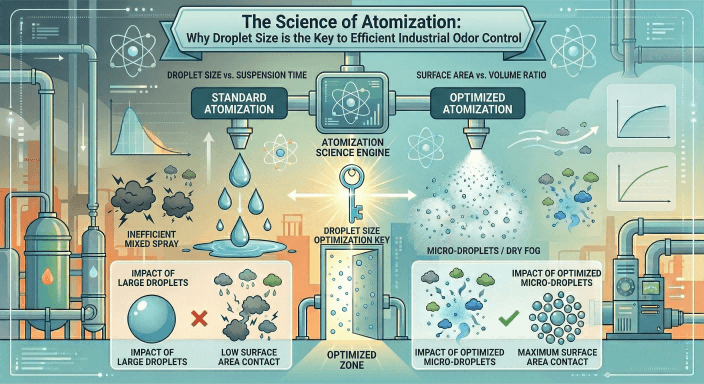
In industrial odor control, bigger is not better. Droplet size directly determines how particles behave in the air:
Contact Probability: Odor molecules exist at the micron level. When we atomize 1 milliliter of liquid into 10-micron dry fog, we generate 1,000 times more droplets than a 100-micron conventional spray. The total surface area increases exponentially. This means the opportunity to neutralize odor molecules multiplies a thousandfold.
Brownian Motion and Suspension: Droplets smaller than 10 microns are minimally affected by gravity. They behave like gas molecules, suspending and diffusing through the air. They undergo Brownian motion. This ensures the deodorizer actively “seeks out” and captures airborne odor molecules rather than falling quickly to the ground.
2. The Hidden Costs of Large Droplets
Many low-end spray systems produce droplets exceeding 50 microns. This triggers a cascade of operational problems:
| Risk Factor | Large Droplets (>50μm) Impact | Micro Dry Fog (5-10μm) Advantage |
|---|---|---|
| Moisture Issues | Wet floors create slip hazards | Dry to touch, no surface moisture |
| Equipment Safety | Causes corrosion on precision instruments | Harmless to electrical equipment and conveyors |
| False Alarms | Triggers smoke detectors, causing shutdowns | Particle distribution avoids detector thresholds |
| Resource Waste | ~70% of chemicals drain to the floor | Nearly 100% participates in air neutralization |
Critical Note: For modern factories operating 24/7, avoiding false fire alarm triggers is a hidden cost that must be factored into equipment selection.
3. Why 5-10 Microns is the “Golden Zone”
Through extensive industrial testing, 5-10 microns has been recognized as the optimal efficiency point for dry fog deodorization. At this size, droplets exhibit gas-like properties. They penetrate into the crevices of waste transfer stations, the dead zones of composting facilities, and the airspace above wastewater treatment pools.
The Airsafer ASX-06 Large Dry Fog Deodorization System is engineered based on this physical principle. Through precision pneumatic atomization technology, it ensures every droplet falls precisely within the 5-10 micron range. It achieves coverage of massive industrial spaces with minimal water consumption.
4. Economic Benefits: Less Consumption, Better Results
Switching to micron-level atomization systems isn’t just a technical upgrade. It’s a financial optimization:
Chemical Savings: Due to extremely high surface area utilization, consumption of dry fog deodorizer can be reduced by over 50% for equivalent odor control results.
Water Conservation: Dry fog systems save 70-80% more water compared to traditional high-pressure sprays. This is crucial for wastewater treatment plants and chemical facilities facing environmental audits.
Maintenance Reduction: No wet surfaces mean no slip-and-fall incidents. No moisture buildup means no equipment corrosion. No false alarms mean no production interruptions.
5. Industry Applications: From Waste Management to Precision Manufacturing
Waste Management and Composting: Dry fog effectively encapsulates hydrogen sulfide (H₂S) and ammonia (NH₃) molecules. It improves community relations by eliminating odor complaints.
Food Processing and Rendering: Rapidly neutralizes intense organic odors without increasing environmental humidity. This prevents mold growth while maintaining air quality.
Municipal Wastewater Treatment: Install at pump stations or screening rooms. Low maintenance costs with no disruption to existing processes.
Manufacturing Facilities: Protects sensitive equipment while maintaining worker comfort. No moisture damage to electronics or machinery.
6. Installation and Operational Advantages
Systems producing optimal droplet sizes require minimal maintenance. There’s no buildup on surfaces. No slippery floors to clean. No corrosion from excess moisture.
Installation is straightforward. Strategic nozzle placement ensures complete coverage. The system operates automatically. It responds to odor levels in real-time. It adjusts output as needed.
The concentrated formula of specialized dry mist deodorants works synergistically with precision atomization. Every molecule reaches its target. Nothing is wasted on the ground.
Conclusion: Measuring Success in Microns
The future of industrial odor control is no longer about simple “spray and cover” tactics. It’s about precise physical intervention. Investing in systems that produce consistent, stable droplet sizes means choosing a safer work environment, lower operating expenses, and better community reputation.
Droplet size determines everything. Too large, and you waste resources, wet floors, trigger alarms, and fail to solve the problem. Too small, and droplets evaporate before neutralizing odors. The sweet spot lies in the 5-10 micron range.
If you’re seeking a solution that won’t wet equipment yet thoroughly eliminates odors, explore our ASX-06 dry fog deodorization technology. The science is clear. The results are measurable. The benefits are immediate.
Modern facilities deserve modern solutions. Solutions measured in microns. Solutions delivered through advanced atomization science. Solutions available now for operations ready to upgrade their approach.
Get a Custom Odor Control Solution Today